
Ben Desjardins
Growth-stage SaaS founders face a blunt choice: pay a fractional CMO to architect your revenue engine or hire a lead gen agency to flood your CRM with meetings. Which model converts pipeline into repeatable ARR at $1M–$10M? That depends on whether you need someone to decide what to build or someone to build it. Understanding the difference saves six figures and six months of wasted motion.

TL;DR: Which Drives Efficient ARR at $1M–$10M?
A fractional CMO outperforms a lead gen agency when your sales team can’t agree on what a qualified lead looks like or when CAC keeps rising despite campaign volume. Agencies win when your ICP, positioning, and channel mix are already locked and you simply need more at-bats. The smart play for most Series A and B teams is a hybrid: a fractional CMO sets strategy, owns KPIs, and coordinates specialist agencies that execute paid, content, or outbound. That model compresses payback periods, eliminates finger-pointing, and scales without adding three full-time hires. Run your own ROI model with real assumptions before you sign anything, because a retainer that looks cheap can bleed cash if it doesn’t line up with revenue metrics.
What You Actually Buy: Scope, Accountability, and Ownership
Fractional CMOs and lead gen agencies operate in different layers of the marketing stack. One owns the blueprint. The other delivers the bricks. Confusing the two creates a gap where strategy and execution never meet, burning budget without moving ARR. The table below captures the scope, decision rights, and measurable ownership of each option so you can match what you need to what you’re actually buying.
Dimension | Fractional CMO | Lead Gen Agency |
|---|---|---|
Primary accountability | ARR growth, CAC:LTV, SQL quality | MQL volume, CPL, ROAS |
Decision authority | ICP definition, positioning, channel mix, pricing inputs | Campaign creative, ad targeting, content topics |
Ownership of revenue architecture | Sets lifecycle KPIs, sales handoff rules, expansion signals | Executes to provided KPIs |
Execution bandwidth | Requires external partners for creative, content, media buying | In-house or networked execution teams |
Feedback loop speed | Weekly cross-functional reviews with sales, finance, RevOps | Campaign-level reporting, monthly QBRs |
Contract structure | Retainer or hourly, 3–12 month terms | Retainer plus media spend or per-lead, 6–12 month minimums |
Fractional CMO pros:
Aligns marketing to board-level revenue goals. Fixes sales-marketing handoff and lead quality definitions. Orchestrates multiple vendors under one strategy. Builds institutional knowledge and systems that outlast contracts.
Fractional CMO cons:
Slower ramp if you lack internal capacity to execute campaigns. Won’t write blog posts, design landing pages, or run ads directly. Requires founder buy-in and cross-functional alignment to succeed.
Lead gen agency pros:
Fast channel activation with in-house creative and media buying. Scales volume quickly once offer-market fit is proven. Lower coordination overhead if scope is tightly defined.
Lead gen agency cons:
No strategic oversight means metrics can look great while ARR stalls. Knowledge walks out the door when contract ends. Quality drift is common as agencies optimize for their KPIs, not yours.
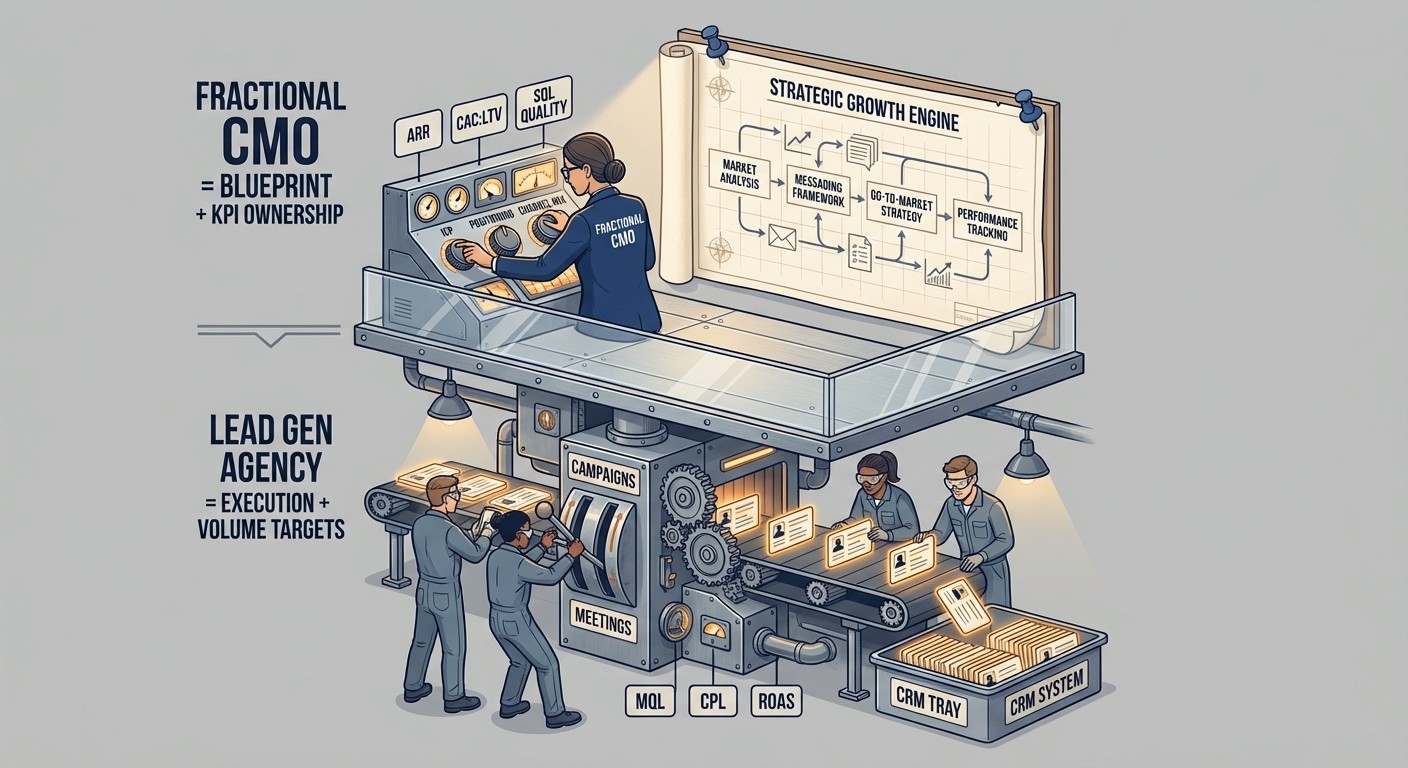
Strategic Ownership of Revenue Architecture
Your fractional CMO decides which segments to target, how to position against incumbents, what pricing levers to test, and which channels deserve budget this quarter. They set the SQL definition with sales, build the attribution model with RevOps, and own the feedback loop when CAC drifts or win rates drop. When your AE team complains that marketing sends junk leads, the CMO rewrites the handoff SLA and adjusts scoring models. When expansion revenue stalls, they map the customer journey and identify upsell triggers. That accountability is contractual. If SQLs convert at 18% instead of the target 25%, the CMO owns the diagnosis and the fix.
Lead gen agencies take the ICP, messaging, and channel brief you hand them and optimize execution within those guardrails. They won’t question whether your target persona has budget or authority. They won’t flag that your pricing page confuses prospects or that your sales cycle lengthened because onboarding friction increased churn signals. Their job is volume within cost targets, not revenue architecture. If CAC climbs, they’ll test new ad copy or audience segments. They won’t rewrite your positioning deck or reallocate budget from paid to product marketing.
That division matters most when your GTM motion is still forming. A fractional CMO builds the machine. An agency runs the machine once it works. Trying to scale execution before you’ve nailed ICP fit and messaging is like hiring a factory before you’ve designed the product. You’ll produce a lot of output that nobody wants to buy.
Execution Capacity and Channel Depth
Fractional CMOs rarely touch the keyboard. They won’t write your case study, design your demo video, or launch your Google Ads account. They hire and manage the freelancers or agencies who will. That means you’re paying for judgment, not labor. In a $15K/month retainer, expect 30 hours of strategic work: weekly pipeline reviews, monthly board decks, quarterly OKR planning, vendor briefs, and sales enablement sessions. The CMO is your head coach. Not your quarterback.
Lead gen agencies bring execution muscle in-house. Creative teams, copywriters, media buyers, SDRs, data analysts. They can spin up a cold email sequence, launch a LinkedIn campaign, and build a content calendar in the same week. That speed is valuable when you’ve already validated your angle and need to flood the zone. But depth varies. Some agencies specialize in one channel and bolt on others as upsells. Others claim full-funnel capability but staff junior teams on anything outside their core. Ask to meet the people who’ll actually run your account. Not the sales executive who closed the deal.
Here’s what tends to happen. Execution breaks when demand scales faster than your internal capacity to support it. Your agency floods inbound. Your SDRs can’t respond in time. Opportunities pile up in your CRM with no next step. Your sales team ignores half the leads because they don’t trust the source. Without a CMO to tune handoff rules, enrich contact data, and coach SDRs on objection handling, volume becomes noise. More pipeline. Same revenue.
KPI Accountability and Feedback Loops
Fractional CMOs own the quality and conversion rates behind the volume. They measure SQL-to-opportunity conversion, cost per qualified opportunity, sales cycle length, and win rate by channel. If paid search delivers 100 SQLs but converts at 8% while organic converts at 30%, the CMO reallocates budget and digs into why paid prospects drop off. They sit in lost-deal reviews, interview churned customers, and feed insights back into targeting and messaging. That closed-loop accountability compresses CAC over time.
Lead gen agencies report on CPL, MQL volume, click-through rates, and ROAS. Those are leading indicators, not revenue outcomes. An agency can hit its CPL target while your sales team complains that leads are unqualified tire-kickers. Without enforceable SQL quality thresholds in the contract, the agency has no incentive to tighten targeting. They’ll optimize what they’re measured on: cost and volume. Not pipeline velocity or revenue.
Feedback speed is the multiplier. A fractional CMO runs weekly cross-functional syncs with sales, product, and finance. When win rates dip or sales cycle stretches, they diagnose root causes in days and adjust ICP filters, messaging, or sales collateral. An agency on a monthly QBR cadence can’t react that fast. By the time they see the signal, you’ve burned another month of budget on the wrong audience.
The best contracts tie agency comp to downstream metrics. Require SQL acceptance rates above 70%, opportunity creation within 14 days, and a minimum SQL-to-opportunity conversion threshold. If the agency can’t deliver, they refund or replace leads. That forces quality discipline and lines up incentives to what actually drives ARR.
Cost Structures and Total Cost of Ownership (TCO) for $1M–$10M ARR
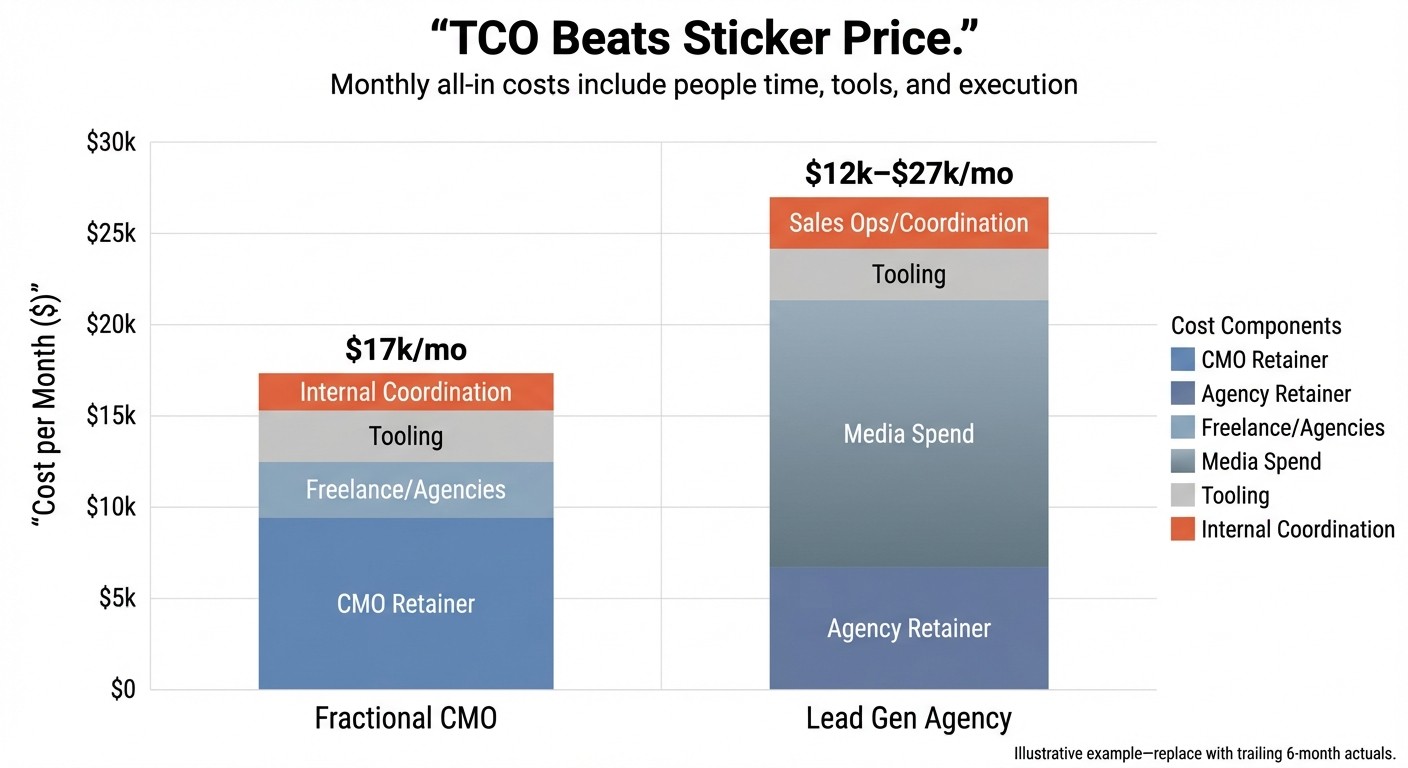
Sticker price is a lie. The retainer or per-lead fee is only the start. TCO includes internal coordination time, creative production, tooling subscriptions, and RevOps support to keep data clean and attribution honest. A $10K/month fractional CMO retainer becomes $18K once you add the content writer, the freelance designer, the intent data platform, and the founder’s 10 hours a week in pipeline reviews. A $5K/month lead gen agency fee becomes $12K after media spend, CRM enrichment tools, and the sales ops hire you need to manage lead routing. Founders who ignore TCO end up surprised when budget runs out halfway through the quarter.
Contract terms also shape cash flow. Fractional CMOs typically bill monthly in advance with 30-day termination clauses after an initial 90-day commitment. Lead gen agencies lock you into six or twelve months with auto-renewal and charge setup fees up front. Payment structures vary. Some agencies bill retainer plus a percentage of ad spend, others charge per qualified lead with volume minimums. Know what you’re signing before the first invoice hits, because switching costs are high once you’ve onboarded systems and trained teams.
Fractional CMO Pricing Models and Typical Ranges
Fractional CMO retainers run $5K–$20K per month depending on company stage, revenue, and scope. A $1M ARR startup with no marketing function pays $6K–$10K for 20–30 hours of strategic work: ICP workshops, messaging frameworks, channel roadmaps, and vendor management. A $5M ARR company scaling into new segments or geographies pays $12K–$18K for deeper cross-functional alignment, board reporting, and hands-on sales enablement. Retainers longer than six months often include quarterly performance bonuses tied to pipeline or revenue milestones.
Hourly engagements range from $150 to $500 per hour. Lower rates come from CMOs in lower-cost geographies or those building portfolios. Higher rates come from specialists with vertical expertise in SaaS, fintech, or healthcare who’ve scaled companies through Series B and beyond. Hourly works for one-time audits, GTM strategy sprints, or advisory relationships where the founder drives execution. It doesn’t work for ongoing accountability or systems-building. You pay for output, not outcomes.
Project-based fees sit between $10K and $50K for defined deliverables: a full GTM strategy, a 90-day channel activation plan, or a sales enablement overhaul. Projects compress time but lack continuity. You get the blueprint, but nobody sticks around to adjust when reality diverges from plan. Hybrid models blend a lower base retainer with performance incentives (usually 1–5% of incremental ARR or 10–20% revenue share on campaigns the CMO directly manages). Hybrids line up incentives but require robust data infrastructure so both sides trust the attribution.
Definition: Total cost of ownership (TCO) is the full price you pay over the engagement period, including retainers, internal support time, tooling, and any external resources the CMO hires. A $10K/month retainer with $5K/month in freelance execution and $2K in software is $17K TCO per month (or $204K annually).
Lead Gen Agency Fees, Contracts, and Add-ons
Lead gen agencies charge retainers between $3K and $15K per month, often with media spend billed separately at cost plus a management fee of 10–20%. A $5K retainer managing $20K in LinkedIn ad spend means your all-in monthly cost is $27K before creative production or landing page builds. Some agencies charge per SQL (typically $50–$300 depending on vertical and deal size). Per-lead pricing sounds performance-based, but agencies define what counts as an SQL and rarely refund leads your sales team rejects.
Contracts include exclusivity clauses that prevent you from running the same channel in-house or with another vendor. Setup fees range from $2K to $10K to cover discovery, account builds, and initial creative. Monthly minimums lock you in even if lead flow drops or quality deteriorates. Optimizations, new creative, and A/B tests are often billed as add-ons rather than included in the base retainer. You’ll also pay for data enrichment, email sequencing tools, and content syndication if those aren’t native to the agency’s stack.
Upsells inflate costs quickly. An agency pitching “$5K/month for LinkedIn ads” might add $3K for copywriting, $2K for intent data, $4K for landing page design, and another $1K for CRM integration. Read the SOW line by line and ask what’s included versus billable. Agencies optimize for their margin, not your efficiency. The more services they can bundle, the stickier the relationship and the harder it is for you to leave.
Hidden Costs You’ll Still Carry Internally
Even with a fractional CMO or agency, you’ll need internal capacity to support execution. Content production requires a writer or editor unless you outsource every asset at $500–$2K per piece. Design work for ads, decks, and one-pagers costs $100–$200 per hour freelance or a $60K+ full-time hire. Sales enablement, battlecards, and objection-handling scripts fall on your product marketing function if you have one. Or your founder if you don’t. Budget 10–15 hours per week of internal coordination even with external partners.
Data and tooling add another $2K–$5K per month. CRM hygiene, enrichment platforms like Clearbit or ZoomInfo, intent data from Bombora or 6sense, attribution software, and analytics dashboards aren’t optional at scale. Your RevOps or sales ops hire owns this stack, and that role costs $80K–$120K annually. If you skip it, your CMO and agency work off incomplete or conflicting data and your board questions every pipeline number.
Founder time is the biggest hidden cost. Expect to spend 5–10 hours per week in the first 90 days. Aligning stakeholders, reviewing strategy, approving creative, sitting in deal reviews. That’s 20–40 hours per month of opportunity cost. If your time is worth $300/hour, that’s $6K–$12K monthly in foregone product or sales work. Done-for-you is never hands-off. Marketing without leadership oversight is just expensive noise.
Ramp Time and Payback Period Expectations
Fractional CMOs need 60–90 days to deliver measurable pipeline impact. Month one is discovery: ICP validation, competitive analysis, messaging workshops, and channel audits. Month two is foundation: GTM roadmap, vendor selection, sales enablement materials, and dashboard setup. Month three is activation. Campaigns launch, feedback loops tighten, and early SQLs enter the funnel. By month four, you should see SQL volume stabilize and conversion rates improve. Payback starts in quarter two once compounding effects, better ICP fit, and optimized sales handoffs reduce CAC by 15–30%.
Lead gen agencies ramp faster but plateau sooner. Expect lead flow within 30–45 days once accounts are live and creative is approved. Volume scales quickly if your offer and targeting are sound. But quality often drifts after 90 days as agencies exhaust your best audiences and chase volume to hit minimums. Payback is faster (often within the first quarter), but long-term CAC efficiency stalls without strategic iteration.
Before/After block:
Before a fractional CMO joins, a typical $3M ARR SaaS company spends $15K/month across three agencies, generates 120 MQLs with a 12% SQL conversion, and sees a $480 CAC with 8-month payback.
After 90 days with a CMO orchestrating those same agencies, MQL volume drops to 90 but SQL conversion jumps to 28%, CAC falls to $320, and payback compresses to 5 months because better ICP targeting and tighter sales handoffs improve win rates and reduce sales cycle length.
Ramp time depends on how much foundational work you’ve already done. If your ICP is clear, positioning is tested, and your CRM is clean, both models accelerate. If you’re still guessing who to target and why they should care, expect the first quarter to feel slow while the CMO builds the scaffolding that agencies need to execute.
ROI Modeling: CAC, LTV, and Pipeline Quality (Worked Examples)
ROI math isn’t optional. It’s how you decide whether to write the check or walk away. The model below uses real SaaS benchmarks at $1M–$10M ARR so you can plug in your own assumptions and see which path pays back faster. The difference between a fractional CMO and a lead gen agency isn’t just cost. It’s how quality compounds over time and whether your CAC:LTV ratio supports sustainable growth or slow death by a thousand mediocre leads.
Choose conservative assumptions on SQL-to-opportunity conversion and sales cycle length. Founders consistently overestimate both. Use your trailing six-month actuals. Not aspirational targets. Quality matters more than quantity: 50 SQLs that convert at 30% drive more ARR than 200 SQLs at 10%, and they do it without burning out your sales team on junk pipeline. Measure what you keep, not what you catch.
Inputs and Benchmarks for B2B SaaS at $1M–$10M ARR
The model uses the following assumptions, which you should replace with your own trailing actuals:
ACV: $25,000 (annual contract value per customer)
Sales cycle: 75 days from SQL to closed-won
SQL-to-opportunity conversion: 22% (industry median for mid-market SaaS)
Opportunity-to-win conversion: 28%
Gross margin: 78%
Net revenue churn: 8% annually
Expansion revenue: 15% annually from existing customers
LTV calculation: ACV × Gross Margin ÷ (Churn Rate + Discount Rate), simplified to 3.2× ACV for this stage
Target CAC:LTV ratio: 1:3 or better
Magic Number: (Net New ARR in Quarter ÷ Sales & Marketing Spend in Prior Quarter). Above 0.75 is efficient growth.
These benchmarks come from SaaS Capital, OpenView Partners, and KeyBanc surveys of Series A and B companies. Your numbers will vary by vertical, deal size, and GTM motion. Enterprise deals with 12-month cycles need different assumptions than PLG models with 30-day sales cycles.
CAC:LTV is the ratio of customer acquisition cost to lifetime value. A 1:3 ratio means you spend $1 to generate $3 of gross-margin-adjusted revenue over the customer’s lifetime. Ratios below 1:3 signal you’re overpaying for growth. Above 1:5 means you’re under-investing and leaving ARR on the table. Magic Number measures sales and marketing efficiency, how many dollars of new ARR you generate per dollar spent last quarter. Above 1.0 is best-in-class. Below 0.5 means you’re burning cash without growth.
Scenario A: Fractional CMO-Led Strategy (Example)
A $3M ARR SaaS company hires a fractional CMO at $12K/month. The CMO tightens ICP targeting, rewrites messaging to emphasize ROI over features, reallocates budget from low-intent paid search to high-intent content and outbound, and fixes the sales handoff by redefining SQLs with the revenue team. Internal support and tooling add $6K/month in TCO, for an all-in monthly cost of $18K (or $54K per quarter).
In quarter one, lead volume drops 20% as the CMO cuts unqualified sources. SQL-to-opportunity conversion climbs from 18% to 26% because targeting improves and sales enablement gives AEs better discovery questions. Opportunity-to-win stays flat at 28%. The company closes 14 new logos in Q1 at $25K ACV each, generating $350K in new ARR. CAC for those 14 customers is $54K ÷ 14 = $3,857 per customer. LTV at 3.2× ACV is $80K. CAC:LTV ratio is 1:20.7. Well above the 1:3 threshold.
By quarter two, compounding kicks in. Messaging and positioning improvements raise win rates to 32%. Sales cycle shortens to 65 days because prospects are better educated before they talk to sales. The company closes 18 logos at the same $18K monthly spend, driving CAC down to $3K and pushing CAC:LTV to 1:26.7. Payback period falls from 7 months to 5 months. Magic Number in Q2 is 1.1, signaling efficient, scalable growth.
Final takeaway: Better ICP fit and tighter sales alignment deliver compounding returns. The CMO’s value isn’t in the first 90 days. It’s in the sustained efficiency gains that make every dollar of spend more productive quarter over quarter.
Scenario B: Lead Gen Agency-Only Tactics (Example)
The same $3M ARR company skips the CMO and hires a lead gen agency at $8K/month retainer plus $15K in media spend (for $23K monthly or $69K per quarter). The agency floods the CRM with 180 MQLs in Q1. Without strategic oversight, the MQL-to-SQL rate stays at 15% and SQL-to-opportunity conversion hovers at 18% because targeting isn’t refined and sales enablement is absent. The company generates 27 SQLs and closes 5 opportunities at 28% win rate, adding $125K in new ARR.
CAC is $69K ÷ 5 = $13,800 per customer. LTV remains $80K, so CAC:LTV is 1:5.8 (still above the 1:3 floor but far worse than the CMO scenario). Payback stretches to 11 months because lower win rates and longer sales cycles tie up pipeline. The agency reports strong CPL and ROAS. But revenue growth stalls.
In quarter two, the agency scales spend to $30K/month to hit volume targets. MQLs jump to 240, but quality continues to drift. SQL conversion drops to 13% as the agency chases lower-intent audiences to maintain CPL. The company closes 6 deals, adding $150K ARR at a CAC of $15K per customer. CAC:LTV falls to 1:5.3. Magic Number is 0.6, signaling inefficient growth. The board asks why marketing spend doubled but revenue growth didn’t.
The delta is clear: volume without strategic guardrails inflates CAC, lengthens payback, and masks pipeline quality issues until it’s too late to course-correct. The agency optimized for its KPIs. The company paid the price in wasted budget and missed targets.
Sensitivity: Conversion Rates and Sales Cycle Length
Small changes in conversion rates and sales cycle create outsized swings in ROI. A 5% improvement in SQL-to-opportunity conversion (from 22% to 27%) increases quarterly logo count by 23% without spending another dollar. A 30-day reduction in sales cycle (from 75 to 45 days) accelerates payback by 40% and frees up sales capacity to work more deals.
Run the sensitivity table below with your own assumptions:
Variable | Baseline | +5% | Impact on CAC | Impact on Payback |
|---|---|---|---|---|
SQL→Opp % | 22% | 27% | -18% | -15% |
Opp→Win % | 28% | 33% | -15% | -12% |
Sales Cycle | 75 days | 45 days | 0% | -40% |
Better ICP fit compounds more than more meetings. A fractional CMO delivering even a 3-point lift in SQL quality and a 10-day cycle compression pays for itself in quarter two and keeps paying in every quarter after. An agency delivering 30% more volume with flat or declining quality burns budget faster than it generates ARR.
For more insights on fractional CMO engagements, explore Sure Shot Systems’ resources and model your own scenarios before you commit.

When to Choose Which: Decision Guide for Founders
Your stage, ACV, runway, and internal talent determine which model fits. Use the list below to self-diagnose, then validate with your CFO and revenue leader before you sign.
Choose a fractional CMO when:
Your sales team can’t agree on what an SQL looks like and lead acceptance rates are below 60%.
CAC is rising quarter over quarter despite steady or growing marketing spend.
You’re preparing for Series A or B and need a unified GTM narrative for investors.
You have budget for strategy but lack internal capacity to own messaging, positioning, and channel orchestration.
You’re scaling into new segments or geographies and need someone to rewrite the playbook.
Your ACV is above $15K and sales cycles are long enough that ICP precision matters more than lead volume.
Choose a lead gen agency when:
Your ICP, messaging, and offer are validated and you simply need more at-bats.
You have internal leadership (VP Marketing or strong founder) who can manage vendors and hold them accountable.
Your ACV is below $10K and sales cycles are short, so volume drives revenue more than quality.
You need fast activation in one or two channels and can’t wait 90 days for strategic ramp.
Your internal team has bandwidth to handle lead routing, enrichment, and sales handoff without external support.
Choose a hybrid model when:
You need both strategy and execution but can’t afford three full-time hires.
You’re growing fast and channel mix is shifting every quarter.
You want to de-risk vendor performance by spreading execution across specialists while centralizing accountability.
You’re willing to pay a 15–25% premium in exchange for faster learning loops and tighter alignment.
Quick-win: If you’re unsure, start with a 30-day fractional CMO audit sprint at $5K–$8K. You’ll get an ICP workshop, a channel roadmap, and a prioritized 90-day plan. If the output makes sense and the founder chemistry works, extend to a retainer. If not, you’ve spent less than one month of a bad agency contract and you’ll have a blueprint to hand the next leader.
The Hybrid That Works: Fractional CMO Orchestrating Specialist Agencies
The hybrid model puts a fractional CMO in the driver’s seat with specialist agencies executing channels under a unified strategy. The CMO owns ICP, messaging, budget allocation, KPI definitions, and cross-functional alignment. Agencies own creative production, media buying, content calendars, and campaign execution. The CMO runs weekly syncs with each vendor, monthly pipeline reviews with sales, and quarterly planning with finance. That operating rhythm eliminates the “strategy-execution gap” where great plans die because nobody owns follow-through.
Hybrid de-risks delivery. If one agency underperforms, the CMO reallocates budget to another channel without renegotiating a master services agreement. If a new opportunity emerges with ABM or your key accounts, the CMO spins up a pilot in two weeks instead of waiting for an RFP cycle. Specialist agencies stay in their lane and do what they do best. The CMO connects the dots and ensures every dollar ladders up to ARR, not vanity metrics.
This model works because accountability is clear. The CMO is the single throat to choke. If pipeline stalls, the founder knows exactly who to call. Agencies can’t point fingers at each other or at the internal team. The CMO owns the outcome and adjusts in real time. That clarity is worth the 15–25% cost premium over a pure-play agency model.
Operating Rhythm and Governance
Hybrid engagements require tight cadence and clean decision rights to avoid coordination overhead. Use this rhythm as a starting template:
Weekly:
30-minute CMO sync with each specialist agency to review performance, adjust targeting, approve creative.
60-minute revenue team sync (CMO, sales leader, RevOps) to review SQL acceptance, pipeline progression, and win/loss themes.
Biweekly:
45-minute cross-functional standup with product, customer success, and finance to surface roadmap priorities, churn signals, and budget variances.
Monthly:
90-minute board-ready pipeline review with full marketing, sales, and finance leadership to assess CAC trends, Magic Number, and forecast accuracy.
Quarterly:
Full-day OKR planning session to set next quarter’s revenue targets, channel priorities, and budget allocation.
Quarterly business review with each agency to reset scope, renew or terminate contracts, and line up on annual goals.
RACI snapshot:
Responsible: Agencies execute campaigns, produce creative, manage ad accounts.
Accountable: Fractional CMO owns revenue outcomes, budget, and cross-functional alignment.
Consulted: Sales, product, and customer success provide feedback on messaging, competitive intel, and customer insights.
Informed: Finance, exec team, and board receive monthly pipeline and CAC reports.
Expert note: Keep marketing, sales, and RevOps synced on definitions. An SQL in your CRM should mean the same thing in your board deck and your agency’s dashboard. Publish a single source of truth in a shared doc and update it every time a definition changes. Without that discipline, you’ll spend half your sync time arguing about whose numbers are right instead of diagnosing why conversion rates dropped.
Budget Allocation: Sample $60k/Quarter Plan
Here’s a realistic quarterly budget for a $3M ARR SaaS company running a hybrid model. Adjust the mix based on your ACV, sales cycle, and channel maturity.
Example budget breakdown:
Fractional CMO retainer: $36K (12K/month × 3 months)
Content agency (SEO, thought leadership, case studies): $9K (3K/month × 3)
Paid media specialist (LinkedIn, Google): $12K retainer + media spend managed separately
Outbound SDR agency (cold email, LinkedIn outreach): $6K (2K/month × 3)
Data and tooling (CRM enrichment, intent data, attribution): $4.5K (1.5K/month × 3)
RevOps support (dashboard maintenance, reporting, lead routing): $7.5K (2.5K/month × 3, part-time contractor)
Contingency and creative production (ad design, landing pages, video): $6K
Total: $81K for the quarter, with $21K in media spend billed separately if you allocate 30% of retainer to paid channels.
Each line item ties to a forecasted pipeline contribution. Content drives 25 SQLs at 30% conversion. Paid delivers 40 SQLs at 20% conversion. Outbound adds 20 SQLs at 18% conversion. RevOps ensures clean data so attribution is trustworthy. The CMO reallocates every 30 days based on what’s working.
This plan assumes you’re past product-market fit and focused on scaling repeatable channels. If you’re still experimenting, shift more budget to contingency and less to retainers so you can pivot fast.
Tooling and Source-of-Truth Analytics
Your minimum viable RevOps stack for a hybrid model includes:
CRM: Salesforce or HubSpot, configured with lifecycle stages that match your SQL, opportunity, and closed-won definitions.
Enrichment: Clearbit, ZoomInfo, or Lusha to append firmographics and contact data so targeting stays accurate.
Intent data: Bombora, 6sense, or G2 Buyer Intent to prioritize accounts showing active research signals.
Attribution: HubSpot attribution or a dedicated tool like Bizible to tie closed revenue back to first-touch and multi-touch sources.
Dashboards: A single exec dashboard in Looker, Tableau, or Google Data Studio that shows SQL volume, conversion rates, CAC, pipeline coverage, and Magic Number updated daily.
The CMO and RevOps own the “single source of truth” so marketing and sales pull from the same dataset. No more dueling spreadsheets or end-of-quarter reconciliation meetings. If the board asks for pipeline by channel, you pull one report and everyone agrees on the numbers.
Attribution doesn’t have to be perfect. First-touch gives credit to the campaign that generated the lead. Multi-touch spreads credit across every touchpoint. Both are useful. Pick one model, document it, and stick with it for at least two quarters so you can spot trends. Changing attribution models mid-year destroys comparability and invites finger-pointing.
Expected Outcomes and Leading Indicators
In a well-run hybrid, expect these benchmarks by the end of quarter two:
SQL quality: 70%+ acceptance rate from sales (measured as SQLs that convert to opportunities within 30 days).
Opportunity creation rate: 25–30 new opps per quarter from marketing-sourced SQLs at $3M ARR, scaling proportionally as revenue grows.
CAC payback: 5–7 months from SQL to cash collected (down from 8–10 months before the CMO joined).
Magic Number: 0.8–1.2, signaling efficient growth that can scale with more investment.
Win rate by source: Marketing-sourced opps convert at or above company average win rate, proving quality matches volume.
Key-takeaway: Prioritize quality signal over top-of-funnel volume. A fractional CMO’s job isn’t to double MQLs. It’s to increase the percentage of MQLs that become customers, shorten the time it takes, and reduce the cost to get there. Volume is easy. Quality compounds.
Risks, Red Flags, and Accountability Clauses
Every engagement has failure modes. Knowing them before you sign gives you the leverage to write protective clauses into your contract and the judgment to walk away if the vendor won’t agree. The most expensive contract isn’t the one you pay for. It’s the one that wastes six months while your competitors pull ahead.
Insist on quarterly performance reviews with pre-defined exit conditions in every SOW. If SQL acceptance falls below 60% for two consecutive months, you can terminate with 30 days’ notice and no penalty. If the fractional CMO misses three consecutive weekly syncs, same outcome. If the agency churns through three account managers in 90 days, you’re out. Put teeth in the contract so accountability is automatic. Not negotiated after things break.
Fractional CMO Watchouts
Over-extended CMOs who carry eight clients can’t give you the attention a $10K retainer deserves. Ask how many active engagements they manage and what their weekly hour cap is per client. If they hedge or won’t commit to a minimum cadence, keep looking. You’re hiring judgment and focus. Not just a Zoom call once a month.
Unclear scope kills value. The SOW should list weekly deliverables, not vague outcomes like “improve marketing performance.” Expect defined outputs: one messaging framework by week four, one channel roadmap by week six, one board deck by week twelve. Outcomes take time to materialize. Outputs prove work is happening.
Absent sales enablement is a warning sign the CMO thinks their job ends at lead handoff. Great CMOs sit in deal reviews, train AEs on discovery questions, build battlecards, and own the feedback loop when objections spike. If enablement isn’t in the scope, add it or find someone else.
Set measurable quarter-end outcomes in the contract: SQL acceptance above 65%, CAC reduction of 10%, or Magic Number above 0.75. Tie a portion of the retainer to hitting those milestones so both sides have skin in the game.
Lead Gen Agency Watchouts
Recycled lists are the fastest way to burn your brand. Ask where leads come from and require contractual proof that contacts opted in and haven’t been sold to five other vendors this quarter. If the agency won’t provide sourcing documentation, walk.
Bait-and-switch SDR quality happens when the agency pitches senior reps in the sales deck but staffs your account with undertrained juniors who read scripts and can’t handle objections. Require named team members in the SOW and a replacement guarantee if turnover exceeds one person per quarter.
Narrow channel dependency makes you hostage to algorithm changes and rising CPMs. If the agency only runs LinkedIn ads and LinkedIn costs double, your pipeline collapses. Require multi-channel capability or accept the concentration risk and budget accordingly.
Vanity SQLs pad the numbers without driving revenue. Define SQL criteria in the contract: title, company size, intent signal, or BANT qualification. Require the agency to log those fields in your CRM for every lead. If 40% of “SQLs” are missing key data, they don’t count toward volume minimums and the agency refunds or replaces them.
Hybrid Engagement Traps to Avoid
Blurred accountability happens when the CMO and agencies blame each other for underperformance. The CMO says targeting is right but creative is weak. The agency says creative is strong but ICP is wrong. You’re stuck mediating instead of growing. Fix this by putting the CMO in charge of budget and KPIs. If results miss, the CMO owns it. The CMO can fire the agency. The agency can’t fire the CMO.
Dueling dashboards create confusion when marketing reports one SQL count, sales reports another, and the agency reports a third. Finance doesn’t know which number to forecast from. Everyone argues and nothing improves. Solve this with a single source of truth dashboard owned by RevOps and audited monthly by the CMO and sales leader.
Unmanaged handoffs between the CMO’s strategy and the agency’s execution lose critical context. The CMO writes an ICP document. The agency skims it and launches campaigns that miss the mark. Require a formal kickoff between CMO and agency at the start of every new initiative and a weekly 15-minute check-in to course-correct in real time.
Recommend one owner for budget and KPIs (the CMO), and one weekly pipeline review that includes the CMO, sales leader, and RevOps. That triangle of accountability catches issues early and keeps everyone on track with what matters: revenue, not reports.
Implementation Checklist: First 90 Days
Use this week-by-week checklist to operationalize whichever model you choose. Hand it to your fractional CMO, your internal team, or your agency on day one so expectations are clear and progress is measurable.
Week 1–2: Discovery and Alignment
Conduct stakeholder interviews with CEO, sales leader, product, customer success, and finance to understand revenue goals, churn drivers, and competitive positioning.
Audit current ICP, buyer personas, and win/loss analysis from the past two quarters.
Review existing campaigns, content, tooling, and vendor contracts.
Map lifecycle stages in CRM and document SQL, opportunity, and closed-won definitions agreed by sales and marketing.
Week 3–4: Strategy and Roadmap
Validate or rewrite ICP based on closed-won customer analysis and sales feedback.
Draft messaging framework and positioning against top two competitors.
Build 90-day channel roadmap with prioritized experiments, required resources, and success metrics.
Present roadmap to exec team and get sign-off on budget allocation and KPI targets.
Week 5–6: Foundation and Enablement
Select and onboard specialist agencies for prioritized channels (content, paid, outbound).
. Brief agencies on ICP, messaging, and KPIs with written creative guidelines and tone of voice standards.
. Build sales enablement assets: one-pagers, battlecards, discovery question guide.
. Configure CRM lead routing, scoring, and automated nurture sequences.
Week 7–8: Activation and Testing
. Launch first campaigns in two prioritized channels with A/B tests on messaging and offer.
. Set up attribution dashboard and daily pipeline Slack alerts for SQL creation and opportunity movement.
. Run first revenue team sync to review lead quality and adjust handoff criteria.
Week 9–12: Optimization and Scaling
. Analyze early results and kill underperforming experiments, doubling down on winners.
. Add third channel if first two are hitting SQL and conversion targets.
. Deliver first monthly board report showing SQL volume, CAC trend, Magic Number, and pipeline coverage.
. Conduct 90-day retrospective with exec team and agencies to set quarter-two OKRs and budget.
This checklist assumes you’re starting from a reasonable baseline: product-market fit validated, CRM in place, and at least one full-time internal resource who can coordinate. If you’re earlier stage, extend discovery to four weeks and delay activation until messaging is tested with real prospects.
Mini-FAQ: Pricing, Contracts, and KPIs
How do fractional CMO retainers ($6k–$20k/month) compare to lead gen agency pay-per-lead costs for Series A SaaS?
Fractional CMO retainers are higher upfront but deliver strategic leverage that reduces long-term CAC. A $10k/month CMO retainer plus $5k in execution costs $15k monthly (or $45k per quarter). A pay-per-lead agency at $150 per SQL needs to deliver 300 SQLs to match that cost. If your SQL-to-customer conversion is 6%, you’d close 18 customers at $45k spend with the agency versus potentially 22 customers at the same spend with a CMO improving conversion to 8%. The CMO’s value compounds as ICP targeting tightens and sales cycles shorten. Lead gen delivers faster initial volume but plateaus without strategic iteration. For more on optimizing your GTM strategy and measuring real pipeline impact, explore Sure Shot System’s approach to revenue marketing.
What is the 6-month total cost of $8k/month CMO retainer versus full-time CMO all-in expenses?
An $8k/month fractional CMO costs $48k over six months. A full-time CMO at $200k base salary plus 20% benefits, equity vesting, recruiting fees, and onboarding time costs roughly $140k over the same period when you account for ramp and opportunity cost. The fractional model saves $92k in cash and eliminates hiring risk. You can terminate a fractional engagement in 30 days if fit is wrong. A full-time hire takes three months to recruit, three months to ramp, and six months to prove value or exit. That’s a year-long commitment before you know if it works.
When does hybrid CMO pricing (such as base plus 1% ARR) outperform fixed agency monthly fees?
Hybrid pricing works when you have the data infrastructure to measure incremental ARR and both sides trust the attribution. A $4k base plus 1% of new ARR works for a $3M ARR company adding $600k annually. The CMO earns $4k × 12 + $6k = $54k total (roughly in line with a $5k fixed retainer but with upside tied to outcomes). Hybrid outperforms fixed fees when growth is lumpy or seasonal because you pay more in high-performing quarters and less when pipeline slows. It underperforms if attribution is contested or if the CMO can’t directly influence revenue because sales execution or product quality is the bottleneck. Use hybrid models only after your first 90 days prove the CMO can move the needle.
Fractional CMO rates by geography: US $10k–$20k vs. India $3k–$7k for global scaling?
US-based fractional CMOs charge $10k–$20k/month because they bring domain expertise in North American buyer behavior, regulatory nuance, and network access to specialist agencies and advisors. India-based CMOs at $3k–$7k/month offer strong execution chops and global SaaS experience but may lack local market fluency if you’re targeting US or European enterprise buyers. For India-based startups scaling into Western markets, a hybrid works well: an India-based CMO at $5k/month plus a US-based fractional advisor at $3k/month for quarterly strategy reviews and customer interviews. That blended model costs $8k/month and balances cost with market knowledge. Geography matters most when your buyer’s decision process, compliance requirements, or brand expectations differ sharply from your home market.
Is project-based CMO pricing (like $10k–$50k) better than hourly for lead gen audits?
Project pricing works for bounded deliverables like a 30-day GTM audit, a channel roadmap, or a messaging overhaul where scope is clear and the output is a document or framework. A $15k project for a full channel audit with prioritized recommendations gives you a blueprint without ongoing commitment. Hourly at $200/hour for the same audit might run 50–75 hours (or $10k–$15k), but scope creep is common and founders end up paying for extra strategy calls that weren’t in the original estimate. Use project pricing when you want a fixed cost and a defined outcome. Use hourly when you need flexibility to expand or contract scope as you learn. For lead gen audits specifically, a $10k–$15k project is cleaner because the deliverable is narrow and time-bound.
Conclusion: Measure What You Keep, Not What You Catch
ROI in marketing isn’t about meeting volume or MQL counts. It’s about qualified pipeline that converts, closes, and renews. A fractional CMO builds the systems that make every dollar more productive over time. A lead gen agency delivers speed and scale when your strategy is already sound. A hybrid combines both and compresses the path from spend to revenue. The best-fit path depends on your stage, ACV, and internal capacity. Not on what worked for someone else’s company.
Run the ROI model with your own assumptions. Plug in your trailing SQL-to-opportunity conversion, your sales cycle, and your actual CAC. See which model pays back faster and scales without burning cash. Then choose the partner who’ll own the outcome. Not just the activity. Growth at $1M to $10M ARR isn’t about doing more marketing. It’s about doing the right marketing and measuring what actually drives revenue.
About the Author
Ben Desjardins is the founder of Sure Shot Systems, a digital marketing agency that cuts through the fractional CMO and lead gen agency noise with transparent ROI modeling and execution accountability. As a three-time founder and published author with over 20 years of growth marketing experience, Ben has sat on both sides of the agency table, building internal marketing teams, hiring (and firing) agencies, and ultimately launching Sure Shot Systems to deliver the strategic clarity of a fractional CMO combined with the execution velocity of a specialist shop, without the inflated retainers or misaligned incentives.
Ben wrote this comparison guide because too many growth-stage founders waste six months and six figures on the wrong model, hiring a lead gen agency when they need strategic scaffolding, or paying a fractional CMO when their real problem is execution bandwidth. Sure Shot Systems operates as a hybrid by design: senior strategists who own CAC, LTV, and pipeline quality like fractional CMOs, paired with in-house execution teams that launch campaigns, build content, and manage media like best-in-class agencies. This structure eliminates the coordination tax and finger-pointing that kills hybrid engagements, while preserving the month-to-month flexibility founders need when runway and priorities shift quarter to quarter.
His clients are Series A and B SaaS companies, B2B service businesses, and commercial contractors scaling from $1M to $10M ARR who demand transparent attribution, real SQL quality definitions, and payback periods measured in months, not fiscal years. Sure Shot's ROI frameworks and decision models (like the worked examples in this article) help founders pressure-test vendor claims, negotiate smarter contracts, and avoid the costly mistakes Ben has seen (and made) across two decades of marketing leadership. Most clients see measurable pipeline impact within 90 days and CAC reductions of 15–30% by quarter two, backed by dashboards that tie every dollar to closed revenue, not MQL vanity metrics. Connect with Ben on LinkedIn


Got a question?
Send us a message. We're happy to help.