
Ben Desjardins
Businesses need strategic marketing leadership, fast and without burning through capital. Fractional CMO services offer executive expertise on a flexible basis. You get instant impact, budget efficiency, and scalable options. This guide breaks down exactly what fractional CMO services deliver, pricing in 2026, and step-by-step hiring instructions for decision-makers.

TL;DR: Fractional CMO services in 2026, what you get and what it costs
Fractional CMOs deliver C-suite marketing leadership at a fraction of full-time cost. They bring advanced strategic planning, revenue accountability, and team coaching, investing 20 to 50 hours monthly or via sprint projects. Engagements start around $4,000/month and top out at $18,000/month (or more for high-growth, complex firms). Typical results land inside 30 to 90 days. This model is ideal for scaleups, post-funding companies, or those in leadership transition.
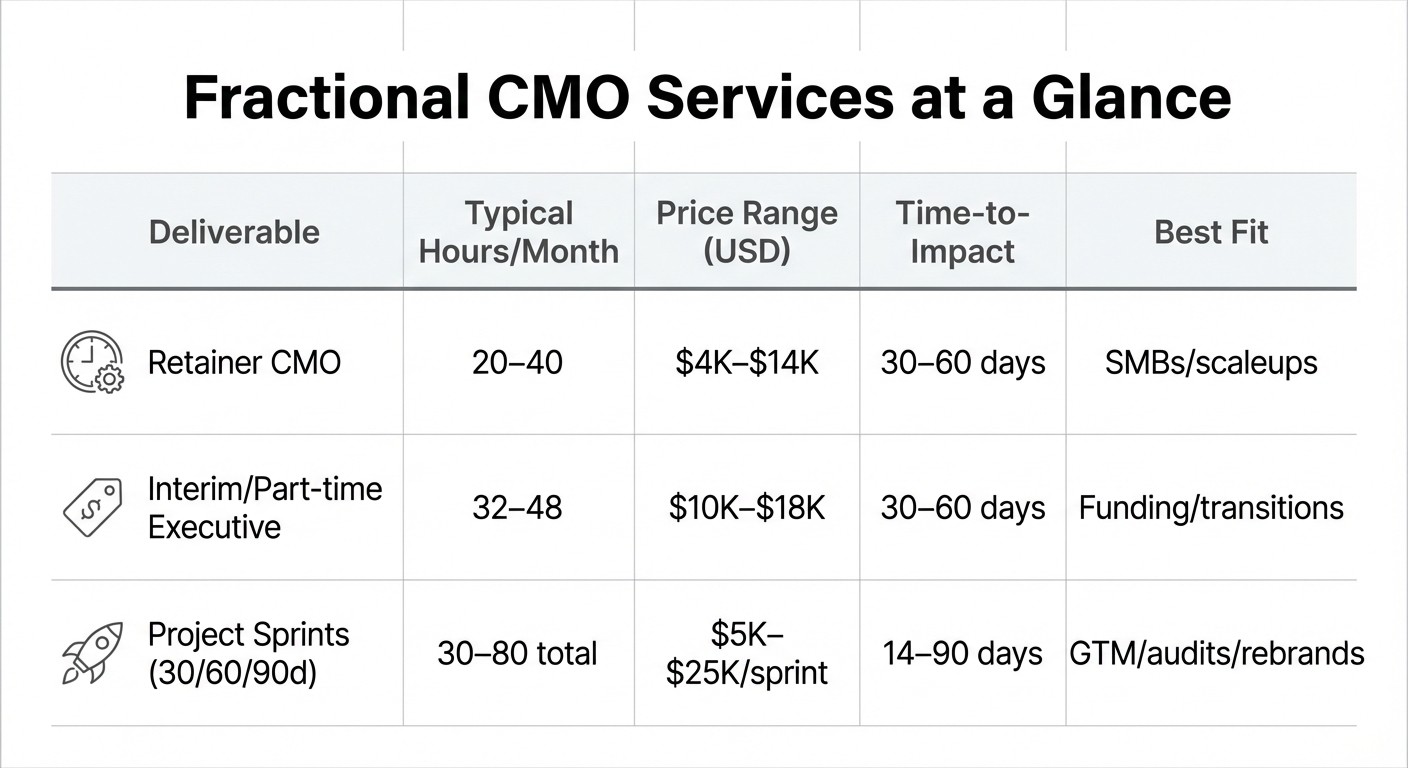
Summary Table: Fractional CMO Services at a Glance
Deliverable | Typical Hours/Month | Price Range (USD) | Time-to-Impact | Best Fit |
|---|---|---|---|---|
Retainer CMO | 20–40 | $4K–$14K | 30–60 days | SMBs, scaleups |
Interim/Part-time Executive | 32–48 | $10K–$18K | 30–60 days | Funding, transitions |
Project Sprints (30/60/90d) | 30–80 total | $5K–$25K/sprint | 14–90 days | GTM, audits, rebrands |
What you get from a fractional CMO
Fractional CMOs give you more than just advice. They build and execute winning strategies, align your team, and bring discipline to decision-making. Expect the following business outcomes:
Sharper go-to-market plans that accelerate revenue
Cohesive messaging reducing confusion with prospects
Aligned sales and marketing, driving pipeline growth
Data-driven forecasting and reporting for the board
Elevated in-house talent and streamlined agency spend
Fractional CMOs don’t just “consult.” They operate as true marketing leaders, embedding into your org to drive performance. This shrinks wasted budget and unlocks new growth.
Strategic foundations: positioning, ICP, messaging, and GTM architecture
A fractional CMO starts by sharpening your strategic core. They clarify your Ideal Customer Profile (ICP), map the buyer journey, refine positioning, and codify messaging. This isn’t theory, it’s a practical, step-by-step playbook that sales, product, and marketing can all follow.
Positioning that aligns with market realities
Clear, actionable ICP profiles for targeting precision
Messaging frameworks to keep teams on-brand
Go-to-market (GTM) blueprints breaking down channel, timing, and budget
With these foundations, your teams stop guessing and start executing with unity and speed.
Revenue engine leadership: demand gen, lifecycle, and sales alignment
A fractional CMO’s focus centers on pipeline responsibility. They lead demand generation initiatives, optimize marketing automation, and tighten sales handoff. You see measurable gains:
Campaigns mapped to funnel stage, not random acts
Higher conversion rates thanks to strategic content and nurture flows
Fewer leaks between marketing and sales
Fractional CMOs drive revenue accountability, ensuring every dollar invested produces trackable progress toward sales goals.
Team and partner management: hiring, coaching, and agency orchestration
Talent gaps? Underperforming agencies? Fractional CMOs fix both. They:
Assess your team, coaching rising talent
Set performance standards and KPIs for all marketers
Oversee agency relationships, negotiating scope and reporting rigor
Plug skill or capacity gaps quickly
The result is an empowered, tightly managed team operating above previous levels.
Metrics, forecasting, and board reporting
Your leadership team needs clean, actionable data, not vanity slides. Fractional CMOs:
Stand up real dashboards linking pipeline to revenue
Forecast leads, opportunities, and deals using historical models
Report monthly and quarterly, bringing new accountability to marketing
This turns board meetings from defensive to proactive. It supports smarter decisions and next-stage growth.

What it costs in 2026: pricing models, ranges, and cost drivers
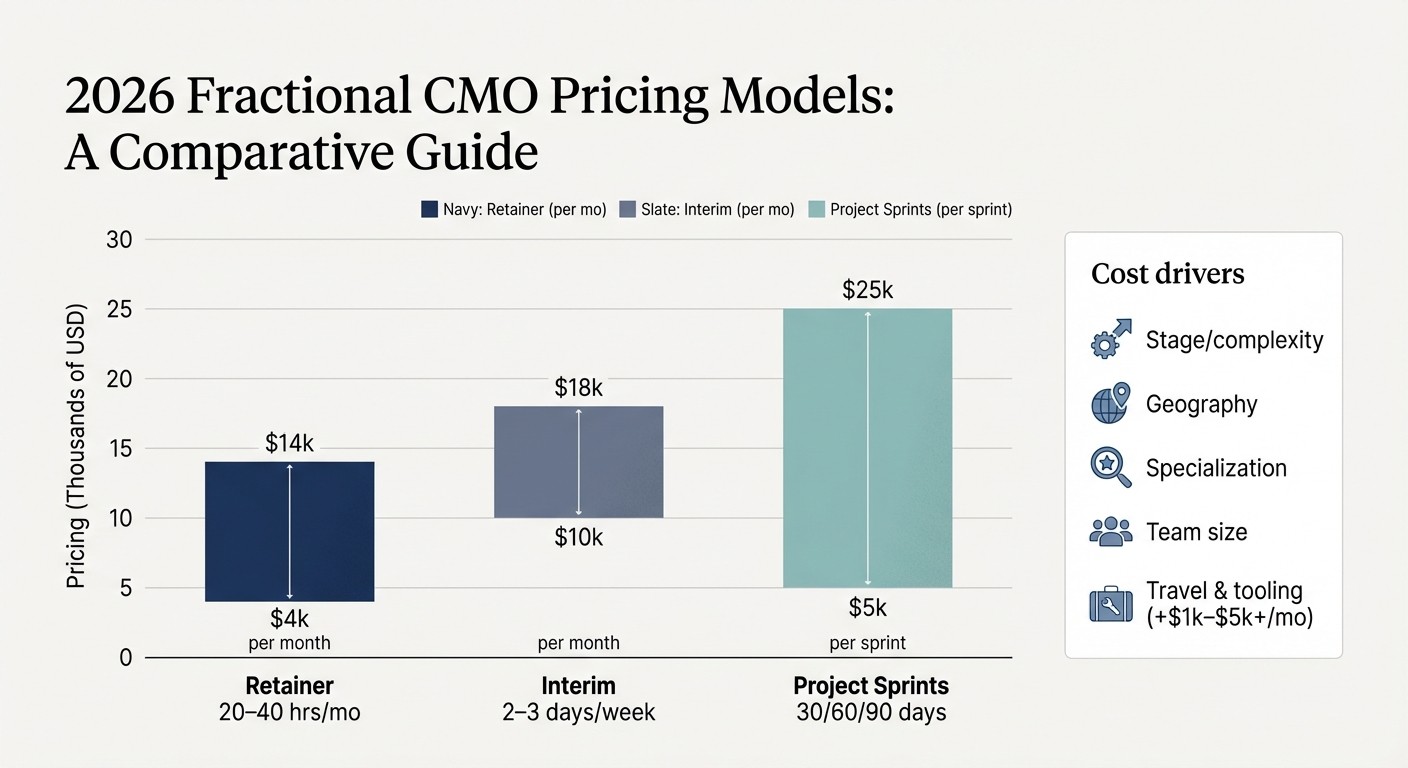
Fractional CMO costs vary by engagement quality, hours, and business complexity. Retainers remain most popular, but sprints and hybrid models grow fast. Here’s what to expect and what drives pricing up or down.
Retainer-based (20–40 hours/month)
Monthly Range: $4,000–$14,000
Hour Commitment: 20–40 hours
Best Fit: Ongoing but flexible needs; scaling teams, mature startups, or midsize B2B
Note: Includes strategy, leadership, meetings, and some execution
Interim/part-time executive (2–3 days/week)
Monthly Range: $10,000–$18,000
Hours: Roughly 32–48/month
Best For: Executive transitions, post-funding growth sprints, or when the CMO seat is vacant
Tip: Offers deeper org integration. Often a step-up from basic retainer if stakes are higher
Project-based sprints (30/60/90 days)
30-Day Sprint Example: $5,000–$10,000 for GTM playbook or audit
60/90-Day Sprints: $12,000–$25,000 for strategic repositioning, relaunch, or major campaign buildout
Work Includes: Strategy docs, gap analysis, plan presentation, first-mover tactics, and handoff
Performance, equity, or hybrid compensation
Structure: Base retainer plus revenue share, equity, or bonus based on delivered results
Caution: Ensure upside incentives align long-term interests, manage risk with defined triggers
Best For: High-risk, high-growth companies with tight cash but high upside
Cost drivers and hidden fees
Total investment is shaped by numerous variables:
Stage/Complexity: Early-stage needs less than enterprise
Geography: Coastal US, UK, and DACH rates highest
Specializations: Demand gen, brand, or vertical expertise drives price
Team Size: Larger teams need more oversight
Travel & Tooling: Onsite workshops, tech stack licenses, and systems setup can add $1,000–$5,000+ monthly
Step 1: Define business outcomes, scope, and budget
To start, set clear goals and budgeting guardrails. Be precise:
Accelerate pipeline by 35% within 90 days
Launch new product to market by end of quarter
Reduce cost-per-lead by 25% quarter-over-quarter
Hire and upskill 2 internal marketers by Q3
Budget: $10,000/month max including all fees
Step 2: Pick the engagement model that matches your risk and timeline
Match your business needs and risk appetite to the right model:
For high-speed, low-risk pilots (under 90 days): Project sprint
If you need steady executive expertise, but flexibility: Monthly retainer (see summary table for hour range and ROI)
For deep integration, interim leadership, or during transitions: Part-time executive agreement
For aggressive growth, but limited resources: Hybrid or performance-based models, minding the risk and complexity
Refer to the executive summary table to align priorities, budget, and ideal fit.
Step 3: Source and shortlist candidates
Here’s where to look:
Referral networks of VCs, founder groups, and board members
Fractional CMO marketplaces and LinkedIn (search "fractional CMO" + industry niche)
Executive search partners specializing in growth teams
Service provider websites with transparent case studies
Screen for:
Deep experience leading marketing in your vertical
Track record of revenue impact, not just brand work
References from CEOs/boards, not just agencies
Shortlist to the top 3 with proven business results and client longevity.
Step 4: Interview and evaluate: questions, work samples, and red flags
Six must-ask questions:
Walk me through a pipeline lift you delivered in 90 days
How do you define and measure marketing ROI?
Share a failure. What went wrong, and how did you correct?
Which key hires have you made and coached in the past 24 months?
How do you handle competing priorities from the CEO, sales, and product?
What’s your first 30-day plan for our business?
Red flags:
Only agency or consulting background, never led in-house teams
Lack of revenue accountability or vague answers on metrics
No recent examples in your company’s size or sector
Unwillingness to share references or specific results
Slides over substance, prioritizes frameworks over execution
Step 5: Select and scope the engagement (SOW, OKRs, and a 30/60/90 plan)
Seal the deal with a clear Statement of Work (SOW):
Scope: Exact hours, deliverables, reporting timeline
OKRs: Measurable, time-bound objectives for each month
Roadmap: Milestones and outputs for the first 30/60/90 days
Contracting Pro-Tip:
Include a 30-day opt-out, IP ownership, data-access, and confidentiality clauses in every SOW.
Step 6: Onboard for impact in the first 30 days
Successful onboarding compresses time-to-value. Stick to this cadence:
Days 1–7: Discovery, audits, and stakeholder alignment
Move quickly, but methodically:
Review dashboards, campaigns, and budget flows
Interview execs and marketing leaders
Audit content, pipeline, tech stack
Establish weekly reporting templates
Days 8–14: Strategy readout and prioritization
Present initial findings in a short strategy readout
Run a decision ritual, choose 3–5 priorities for first wins
Lock in alignment across teams before moving to execution
Days 15–30: Launch priorities and operating rhythm
Launch at least one high-impact campaign or process
Set up weekly metrics review and standups
Establish clear reporting to C-suite/board
Prep roadmap for next 90 days

How to measure ROI and decide whether to continue or convert to full-time
Break ROI down to marketing-sourced revenue vs. total spend. If new pipeline covers 2–3x the monthly fee within a quarter, you’re near a break-even. Review every 90 days. Extend, expand, or convert based on real results.
Leading vs. lagging indicators to track by week and quarter
Weekly: New leads, SQLs, campaign engagement rates
Quarterly: Pipeline dollar growth, win rates, CAC trends
Tie all metrics to key sales cycle stages and your typical deal close time
Cost comparison: fractional CMO vs full-time CMO total cost of ownership
Full-time CMO:
Salary: $180K–$350K+
Plus benefits, equity, recruitment fees, ramp-up = $250K–$500K/year
Fractional CMO:
Total: $48K–$216K/year (depending on hours and scope)
Immediate impact, no long-term liability, lower ramp risk
Conversion triggers and timing
“Graduate” to a full-time CMO or convert your fractional leader when:
Marketing becomes your main growth lever
Complexity outpaces part-time capacity
You need daily cross-functional presence
The same CMO delivers repeated, compounding impact over 6–12 months
Common pitfalls to avoid when hiring a fractional CMO
Expecting consulting-only delivery, fractional CMOs should lead and execute
Setting vague or immeasurable goals, untracked progress erodes ROI
Underestimating onboarding, skipping alignment slows impact
Misaligning incentives, unclear performance pay can backfire
Ignoring talent coaching, missed opportunity for upskilling your in-house team
Templates and resources (2026)
30/60/90 Day Plan Template: Fast-start checklist for your new CMO, with week-by-week milestones
SOW Checklist: Covers scope, KPIs, reporting, opt-out, and confidentiality must-haves
Interview Scorecard: Criteria-based worksheet for fast, apples-to-apples candidate comparison
Ready for board-level marketing leadership, without long-term headcount risk? Book your zero-obligation discovery call at https://sureshotsystems.com and put your pipeline in executive hands.
Frequently Asked Questions (FAQ)
What does a fractional CMO actually do?
A fractional CMO provides part-time executive marketing leadership. They set strategy, lead your team, manage vendors, and drive revenue goals, working a set number of hours weekly or by project.
How soon will we see results?
You’ll spot first signals in 2 to 3 weeks, with measurable pipeline and revenue impact within 30 to 90 days in most cases.
Who is a fractional CMO best for?
Growth-stage companies, funded startups, SMBs scaling into new markets, or any business needing top-tier marketing leadership without full-time cost.
How does a fractional CMO differ from a marketing consultant?
Unlike consultants, fractional CMOs embed into your org, lead teams, own outcomes, and are held accountable for pipeline, not just recommendations.
How much does a fractional CMO cost compared to full-time?
Fractional CMO: $4K–$18K/month. Full-time CMO: $250K–$500K/year with all costs included. Fractional offers agility and lower risk.
Can a fractional CMO manage our existing marketing team?
Yes. They will lead, coach, set KPIs, handle hiring, and often oversee agency partners as well.
When should I hire a fractional CMO instead of full-time?
When you’re not ready for a $300K+ commitment, you need impact fast, or you need flexible leadership during transitions.
What outcomes should I expect in the first 90 days?
A clear strategy, pipeline acceleration, weekly metrics, and stronger team performance should all be visible within the first 90 days.


Got a question?
Send us a message. We're happy to help.