
Or What’s the Layered Demand Capture Framework
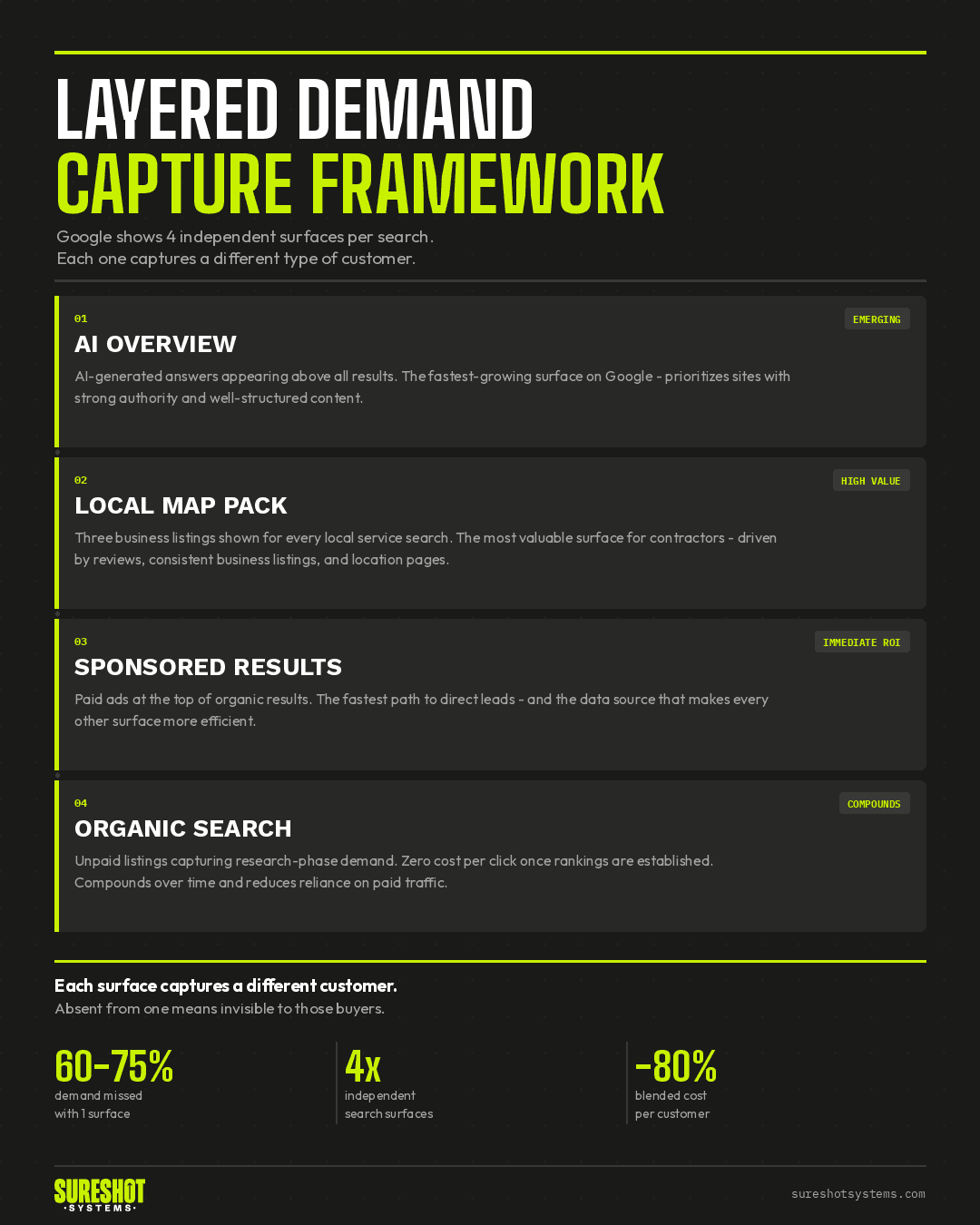
If you're paying for Google Ads, doing SEO, or trying to rank in the map pack, you need to understand something most marketing agencies won't tell you:
You're not competing on Google. You're competing across four completely separate demand capture surfaces.
And if you're only winning on one surface, you're leaving most of your potential customers on the table.
This article explains the Layered Demand Capture Framework (LDC Framework), a digital marketing strategy developed by Ben Desjardins to scale local businesses with a focus on rapid ROI..
What Is a "Demand Capture Surface"?
A demand capture surface is any place where customer intent gets captured and converted into a business transaction.
When someone searches "emergency plumber near me," they have intent i.e. they need a plumber.
That intent gets captured somewhere on the search results page.
Google has four distinct surfaces where this happens:
AI overview: the AI-generated answer at the very top (newer, growing fast)
Local map pack: the map showing 3 businesses
Sponsored results: the paid ads at the top of organic results
Organic results: the unpaid listings below the ads
Each surface operates independently. Different algorithms. Different ranking factors. Different user behavior.
Remember this: A customer searching for your service will pick ONE business from ONE surface.
If you're not on that surface, you didn't exist in their decision.
The Problem With Single-Surface Strategy
Most contractors approach Google marketing like this:
"We're running Google Ads" (competing on one surface)
"We're doing SEO" (competing on one surface)
"We're optimizing our Google Business Profile" (competing on one surface)
This creates three major problems:
Problem #1: You're invisible to most searchers
Research shows different customers use different surfaces:
Some people scroll past ads and only click organic results
Some people only look at the map
Some people trust the AI overview and never scroll
Some people click the first ad they see
If you're only dominant on one surface, you're missing 60-75% of available demand.
Problem #2: Your acquisition costs stay high
When you rely on one demand capture surface, usually ads, your cost per lead is tied directly to bidding and competition.
If click prices go up, your costs go up.
But when you capture demand across multiple surfaces (sponsored, local, organic, AI) your blended cost per acquisition decreases over time.
Organic clicks don’t cost per click.
Map pack calls don’t require bids.
AI visibility doesn’t run on ad spend.
The more surfaces you cover, the less dependent you are on paid traffic alone, and your cost per new customer eventually drops.
Problem #3: You're fragile
Single-surface strategies are vulnerable:
Google changes the ad auction: your cost per click doubles overnight
Algorithm update (happens all the time) your organic traffic drops 40%
Google Business Profile suspension: your phone stops ringing
Competitor dumps money into ads: you get priced out
You have no redundancy. One bad month and your lead flow collapses.
How Multi-Surface Demand Capture Actually Works
Most contractors see marketing as isolated disciplines (ads, SEO, etc.).
But the demand capture surfaces aren't isolated. They reinforce each other when you layer them correctly.
The most effective approach isn't doing everything at once, it's sequencing your investment so each layer makes the next one more efficient.
Start With Immediate Demand (Sponsored Surface)
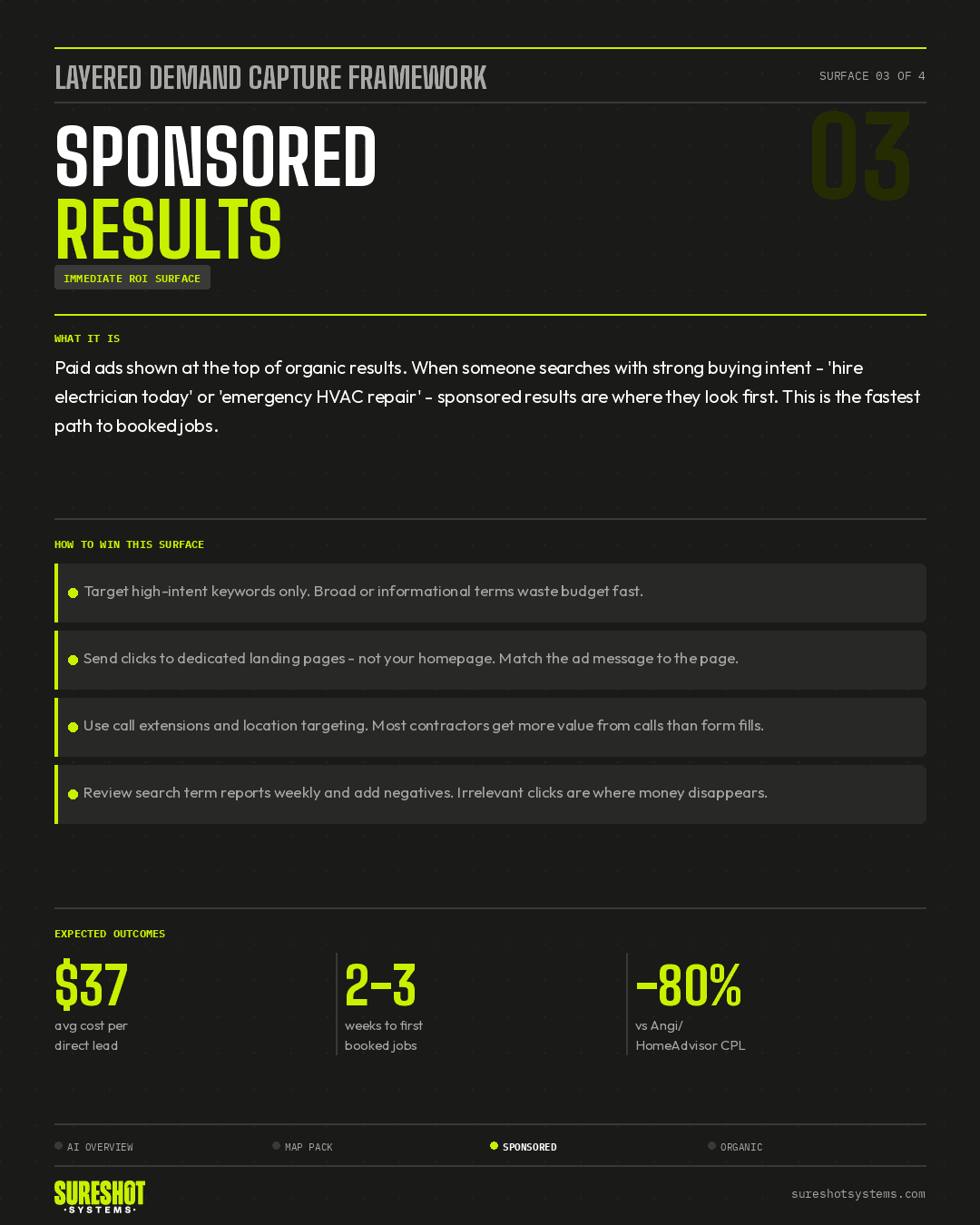
Paid search captures high-intent customers right now.
Someone searching "hire electrician today" or "emergency HVAC repair" has commercial intent. They're ready to buy.
This is your fastest path to revenue.
Even more important: running ads also gives you data.
You learn which keywords convert. Which service pages work. What your actual customer acquisition cost is.
That intelligence informs everything else.
Build Conversion Infrastructure (All Surfaces Benefit)
Before you scale traffic, you need a website that actually converts visitors into calls.
Most contractor websites lose 97% of their traffic because:
The headline doesn't immediately tell people what you do
There's no clear phone number or contact button
The site loads slowly on mobile
There's no trust signals (reviews, past jobs, credentials, years in business)
When you fix conversion rate, every surface gets more efficient.
If your site converts at 2% and you improve it to 4%, you just cut your cost per lead in half across every channel.
Capture Organic Demand (Organic Surface)
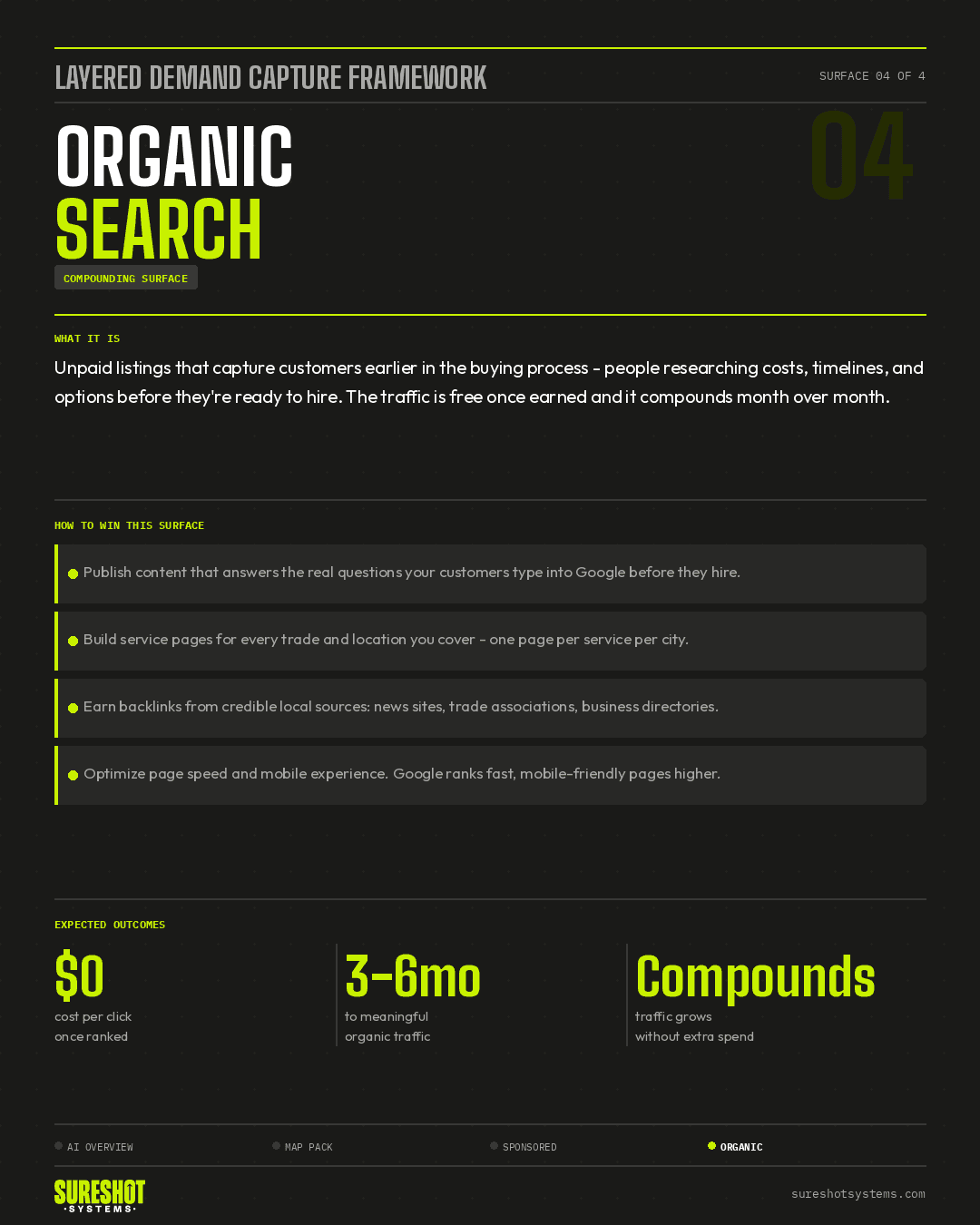
Most customer searches aren't "hire a contractor right now."
They're earlier in the journey:
"How much does it cost to replace a roof?"
"Do I need a permit to remodel my bathroom?"
"How long does a water heater last?"
These are research queries. The customer isn't ready to hire yet, but they will be.
When you create content that answers these questions, you capture demand at the research phase.
This traffic is free. It compounds over time. And it builds trust before they ever call you.
This is how you show up in organic results.
Expand Local Demand Capture (Map Pack Surface)
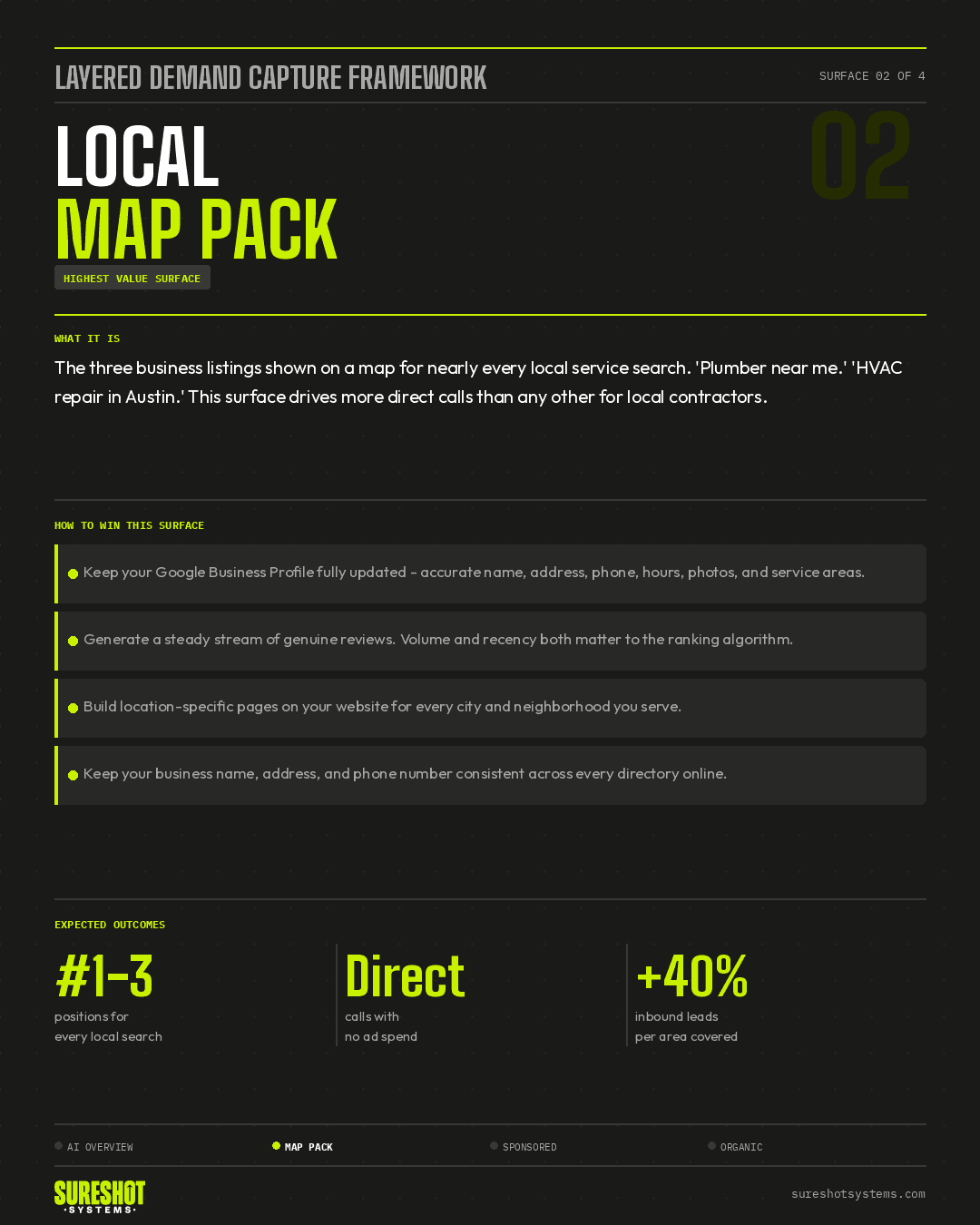
The local map pack is the most valuable surface on Google for contractors.
It appears for nearly every service + location search:
"plumber in Austin"
"HVAC repair near me"
"roofing contractor in [neighborhood]"
Most contractors optimize their Google Business Profile and hope for the best.
But map pack rankings aren't just about your GBP.
They're influenced by:
How many location-specific pages you have on your website
Whether your business name, address, phone number are consistent everywhere online
How much localized content you're publishing
The number and quality of reviews you're getting
When you systematically create service pages for every city and neighborhood you cover, you expand your map pack footprint.
You're not just competing for "plumber in Austin". You're competing for "plumber in West Lake Hills," "plumber in Tarrytown," "plumber in Hyde Park."
You capture more local demand because you're visible in more local searches.
Each neighborhood page is another opportunity to appear in those three coveted map pack positions.
Build Authority (Organic, Map Pack, and AI Surfaces)
Authority is what makes everything more efficient.
When your website has high authority (earned through backlinks from credible sources), Google trusts you more.
This means:
Your organic content ranks higher with less effort
Your map pack position becomes more stable
Your website is more likely to be cited in AI overviews
You build authority by getting backlinks from:
Local chambers of commerce
Industry associations
Local news sites
Relevant directories
Each backlink is a vote of credibility.
Authority compounds and makes all your other surfaces stronger without additional spending.
Future-Proof With AI (AI Overview Surface)
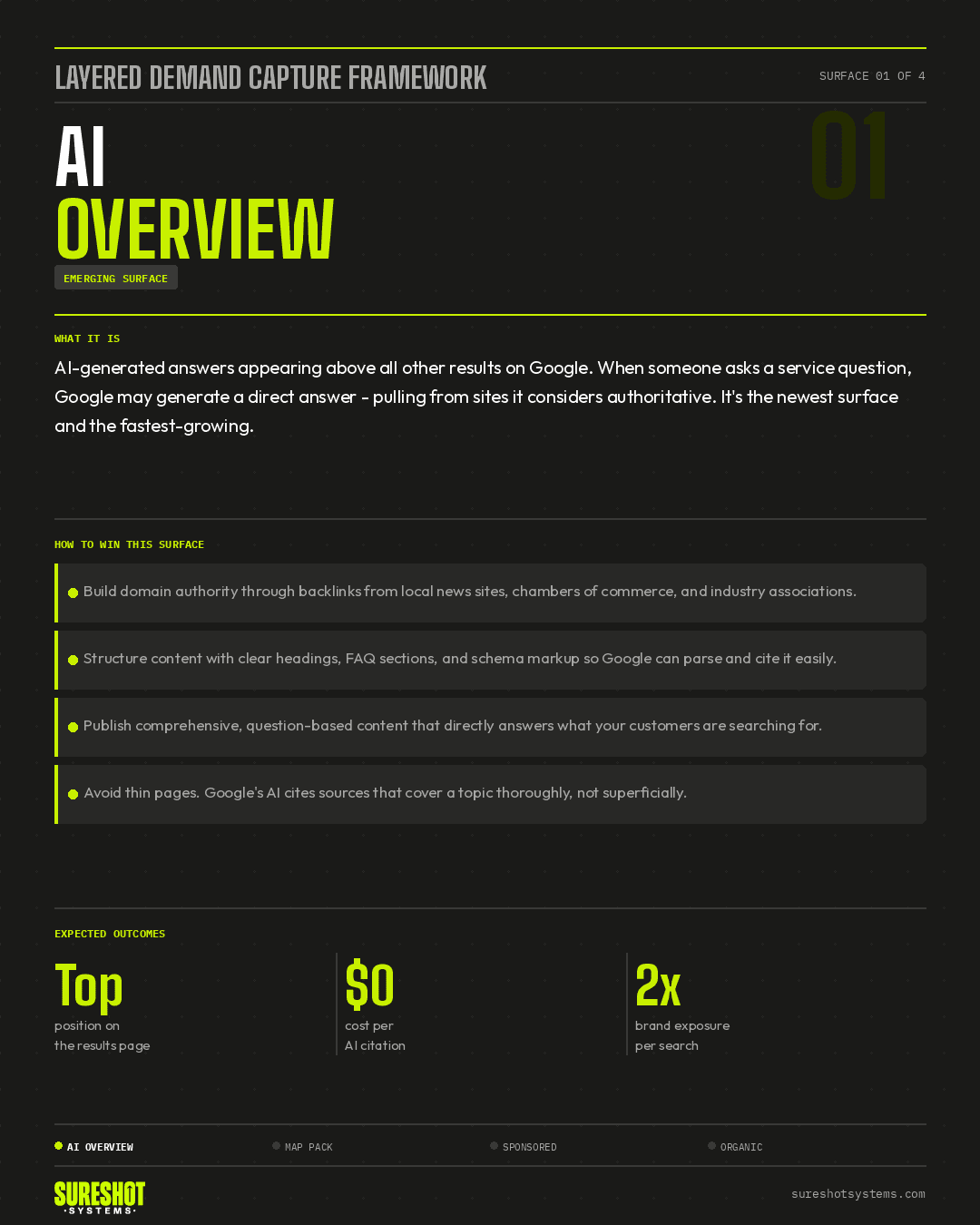
The fastest-growing surface is AI-generated answers.
When someone asks "what's the best way to find a reliable contractor," Google's AI might generate an answer that references your website.
This is brand new territory, but early signals show AI overviews prioritize:
Websites with strong authority (backlinks)
Content structured with schema markup (machine-readable data)
Sites that comprehensively answer questions (not thin content)
If you're already building authority and creating good content, you're positioning for AI visibility without extra work.
Why Layering Reduces Acquisition Cost
The math is quite simple and relates to cost-averaging. Let’s compare a single-surface strategy (Ads in the Sponsored Results surface) vs a multi-surface strategy.
Single-surface strategy:
You pay $50 per click on Google Ads
5% convert to customers
Your cost per customer = $1,000
Multi-surface strategy:
You still pay $50 per click on Google Ads
But now you also get:
10 free calls per month from organic content
8 free calls per month from map pack rankings
3 inquiries from AI overview citations
Your blended cost per customer drops to $600.
You didn't spend more. You captured demand from more surfaces.
As organic and map pack traffic grows, your reliance on paid ads decreases.
After 12 months:
Your ad spend might be the same
But you're getting 2-3x more customers
Your cost per customer is now $400
That's how multi-surface demand capture works in practice.
Why Layering Matters
Unless you have a full marketing department and a large budget, you can't do everything at once.
The mistake most contractors make is spreading budget thin across all surfaces without a strategy.
They run ads inconsistently
They publish a few blog posts with no plan
They create a couple city pages and stop
This random execution is not a framework.
Effective layering looks like this:
Fix conversion infrastructure so every surface performs better
Start with sponsored results to generate immediate revenue and validate your keywords
Build organic content to capture research-phase demand
Create local pages to expand map pack visibility
Earn authority to make everything else more efficient
Each layer funds the next one.
The revenue from sponsored results pays for content creation.
The traffic from organic reduces your dependence on ads.
The authority from backlinks makes your organic and local rankings more stable.
This is why it's called "layered" demand capture. Each layer builds on and reinforces the previous one.
The Compounding Effect
Single-surface marketing is linear.
Spend $5,000 on ads → get 10 customers
Spend $10,000 on ads → get 20 customers
Multi-surface marketing compounds.
Month 1: Ads generate 10 customers
Month 2: Ads generate 10 customers + organic generates 3 customers
Month 3: Ads generate 10 customers + organic generates 8 customers + map pack generates 12 customers
Your total customer volume increases without increasing ad spend.
This is what sustainable, scalable growth looks like.
The Bottom Line
Most contractors think they're competing for Google rankings.
They're not.
They're competing for demand capture across four independent surfaces.
If you're only winning on one surface, you're:
Paying more per customer than you need to
Missing 60-75% of available demand
Vulnerable to algorithm changes and competitive pressure
The contractors who dominate their markets aren't doing one thing better.
They're capturing demand from more surfaces.
That's the Layered Demand Capture Framework.
It's a strategic approach to how demand actually works, and this example is about Google specifically. However the LDC Framework can be applied to other digital platforms.
If you’d like to know how that could work for your business, schedule a quick consultation with one of our LDC Framework experts.
Frequently Asked Questions
What is the Layered Demand Capture Framework?
The Layered Demand Capture (LDC) Framework is a digital marketing strategy that focuses on capturing customer demand across four Google search surfaces: AI overviews, the local map pack, sponsored results (Google Ads), and organic search results. Instead of relying on a single channel, the framework layers multiple strategies to increase visibility and reduce customer acquisition costs.
Why is relying on only one marketing channel risky?
Single-channel marketing strategies, like only running Google Ads or only focusing on SEO, leave businesses vulnerable. Algorithm changes, rising ad costs, or platform disruptions can quickly reduce lead flow. A multi-surface strategy creates redundancy so that if one channel declines, others continue generating customers.
How does multi-surface demand capture reduce acquisition costs?
When businesses generate leads from multiple surfaces, the overall cost per customer decreases. Paid traffic may drive initial demand, but organic rankings, map pack visibility, and AI citations generate additional leads without ongoing advertising costs. This blended approach lowers the average acquisition cost over time.
Why is the Google Map Pack important for local businesses?
The local map pack appears for most service-related searches such as “plumber near me” or “HVAC repair in [city].” Because it shows only three businesses, ranking in the map pack dramatically increases calls and local visibility. Strong reviews, consistent business listings, and location-based pages all influence map pack rankings.
How does organic content help contractors generate leads?
Organic content captures customers earlier in their buying journey when they are researching questions like costs, timelines, or repair options. By publishing helpful content that answers these questions, contractors build trust and attract search traffic that can convert into future customers.
What role do backlinks play in Google visibility?
Backlinks from credible websites, such as local news outlets, industry associations, and chambers of commerce, signal authority to Google. Higher authority improves organic rankings, strengthens map pack performance, and increases the chances of being cited in AI-generated search results.
How long does it take for a layered marketing strategy to work?
Paid search campaigns can generate leads almost immediately, while SEO, map pack visibility, and authority building typically take several months to compound. Over time, these additional surfaces reduce reliance on ads and significantly lower customer acquisition costs.
About the Author
Ben Desjardins is the founder of Sure Shot Systems, a digital marketing agency that helps contractors and service businesses capture demand across the multiple search surfaces that shape how customers choose who to hire online. As a three-time founder and published author with more than 20 years of experience in growth marketing, Ben has worked on both sides of the agency relationship, building internal marketing teams, managing paid media and SEO programs, and helping businesses translate online search behavior into measurable revenue.
Ben wrote this guide to explain the thinking behind the Layered Demand Capture Framework (LDC Framework), a strategic model developed after years of seeing contractors invest heavily in a single marketing tactic while competitors quietly dominated multiple positions on the same Google search results page. Instead of treating Google as one ranking system, the framework views it as four independent demand capture surfaces: AI overviews, the local map pack, sponsored results, and organic listings. By understanding how these surfaces operate and how customers interact with them, businesses can design marketing systems that capture demand more efficiently and reduce reliance on any single channel.
Sure Shot Systems applies the LDC Framework to help contractors and service companies build marketing strategies that generate immediate leads while creating long-term visibility across Google’s evolving search ecosystem. By layering paid search, organic content, local search optimization, and authority building in the right sequence, the approach increases total demand capture while steadily lowering customer acquisition costs over time. Ben regularly publishes practical frameworks and guides to help business owners understand how modern search actually works so they can make smarter marketing decisions and avoid the costly trial-and-error that defines much of the marketing industry. Follow Ben on LinkedIn.


Got a question?
Send us a message. We're happy to help.