3/4/26
Ben Desjardins
Tracking return on investment for hvac marketing has never been more critical. The gap between spending on brand awareness and generating actual jobs booked continues to widen. Contractors need precise benchmarks for every dollar, from postcard campaigns to search ads. This guide unpacks real performance metrics and walks through documented campaigns that produced measurable revenue, not just impressions.

TL;DR: HVAC Marketing ROI Benchmarks at a Glance
Direct Mail: Expect 0.5% to 2.5% response rates. Cost per lead ranges from $40 to $110. Close rates typically sit at 15% to 30%. Return on ad spend hovers around 4:1 to 13:1 when targeting older systems in serviceable ZIP codes.
PPC (Google Ads + LSA): Emergency repair keywords run $25 to $95 per click. Conversion rates land between 8% and 18%. Cost per lead is $85 to $210. Install-focused campaigns drive 9:1 to 13.24:1 profit multiples during peak heat waves.
SEO (Local + Content): Months three to six show costs per organic lead drop from $180 to under $70. By month 12, stabilized CPL often hits $40 to $60 with a 30% to 40% close rate. Total ROAS compounds to 10:1 or higher over 18 months.
Social (Paid + Remarketing): Expect $8 to $22 CPM, 1.2% to 3.5% CTR, and $120 to $280 cost per lead on cold audiences. Retargeting slices search CPL by 15% to 25%. Assisted ROAS runs 3:1 to 6:1 when paired with paid search.
A full comparison table appears below, breaking down CPL, close rate, average order value, and payback for each channel.
Methodology: How These HVAC ROI Benchmarks Were Calculated
All data in this analysis was compiled from named vendors and agency case studies published between January 2022 and December 2024. Sources include Valpak’s residential lead generation reports, PostcardMania’s 34-campaign ROI study, WebRunner Media’s PPC heat-wave tests, Mediagistic’s Yelp-spend analyses for Tucson and Phoenix, First Page Sage’s commercial SEO builds, Blue Corona’s installation bid shift experiments, and Marketing 360’s social retargeting pilots.
Revenue figures were normalized to booked jobs rather than raw leads. Gross margins were calculated at 40% for repairs, 25% for installations, and blended to 32% for mixed service shops. Customer lifetime value was estimated over 36 months (including maintenance agreements and repeat calls). Geographic cohorts spanned Sun Belt markets (Phoenix, Tucson, Las Vegas), Mid-Atlantic regions, and Midwest zones. All spend reflects actual campaign budgets, not projected estimates.
Definitions: CPL, CPA, ROAS, LTV by Service Line
Cost per lead (CPL) is total marketing spend divided by attributed inbound calls or form fills that meet qualification criteria (service address in footprint, named contact, appointment requested). Cost per acquisition (CPA) adds the close-rate filter, so only booked jobs count. ROAS is gross revenue from attributed jobs divided by ad spend. LTV tracks 36-month value per customer, including maintenance tune-ups and referrals.
For example, a $59 repair visit that converts to a $3,950 AC replacement yields $4,009 gross revenue. At 25% margin that’s $1,002 profit, minus $75 CPL, net $927 per customer. A maintenance agreement adds $180 annual value across three years.
Cohorts: Residential vs Commercial, Repair vs Install, Seasonality Bands
Residential campaigns split into emergency repairs (furnace failures, AC outages) versus planned installs (system replacement quotes). Commercial efforts target facility directors, property managers, and multi-tenant building owners. Repair work peaks in summer (AC) and winter (heating). Installs spike in shoulder seasons when weather is mild and rebates launch.
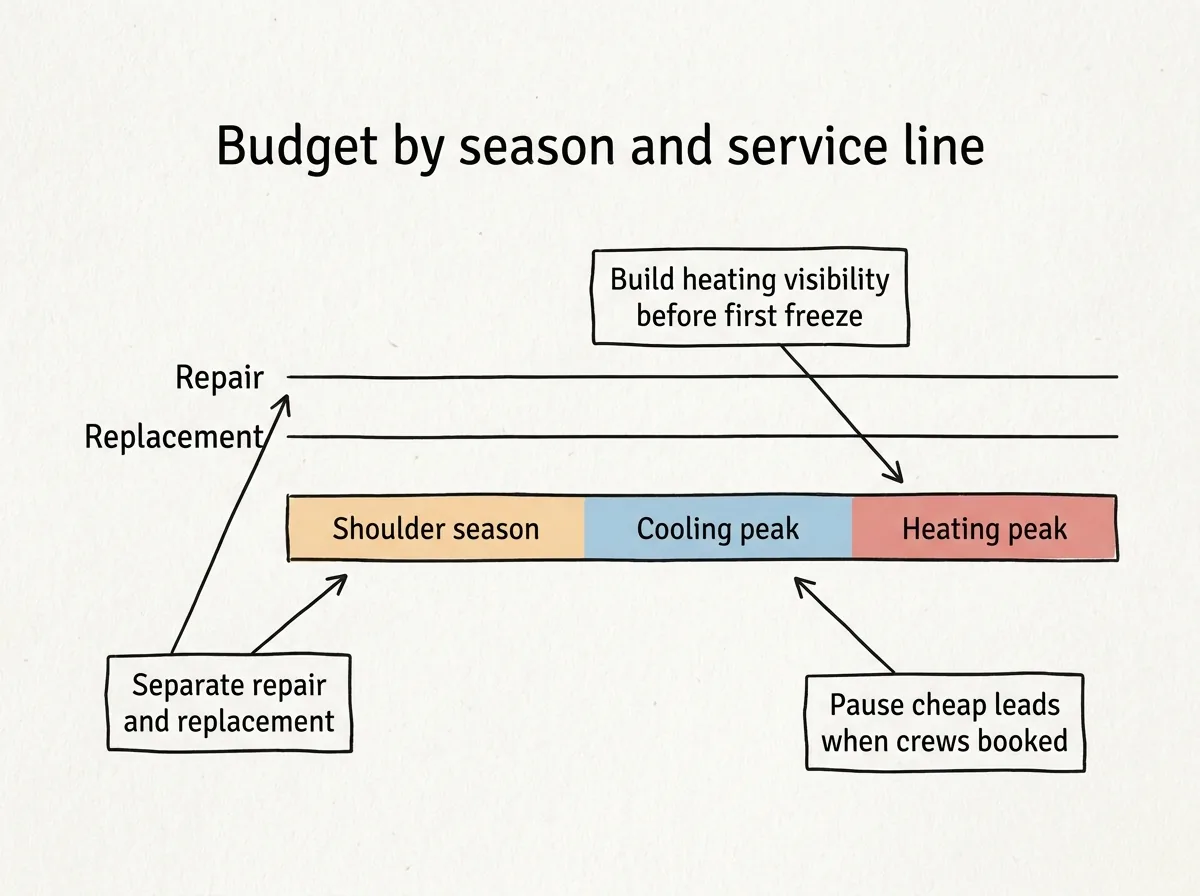
Seasonal bands adjust benchmarks: peak months drive 40% to 60% higher CPCs but 20% to 35% better close rates because intent is hotter. Off-peak efforts see lower cost per click yet longer sales cycles. Direct mail response rates climb 30% when mailed 90 days before the expected failure window for aging systems.
Direct Mail (Postcards/Valpak): Benchmarks and Case Studies
Direct mail wins when you can identify ZIP codes with older HVAC systems and mail a compelling offer tied to a trackable phone number or QR code. Response rates run 0.5% to 2.5% depending on list quality and offer strength. Cost per lead lands at $40 to $110. Close rates on qualified leads range from 15% to 30%. ROAS typically hits 4:1 to 13:1 when you track calls through dispatch and attribute booked revenue back to the mail drop.
Winning offers include $50 off any repair, $500 off new system installation, or free tune-up with paid service call. Tracking is non-negotiable. Use a dedicated phone number or vanity code so your dispatcher logs the source. Without attribution, half your ROI disappears into untracked conversions.
If you’re scaling beyond online lead generation, integrating offline mail with call tracking bridges the gap and makes sure every marketing dollar ties to a job on the board.
Benchmarks: Response Rate, CPL, Close Rate, ROAS
Metric | Conservative | Optimized |
|---|---|---|
Response Rate | 0.5% | 2.5% |
Cost per Lead | $85 | $40 |
Close Rate | 15% | 30% |
Average Job | $1,378 | $8,849 |
ROAS | 4:1 | 13:1 |
List quality is king. Scrubbed homeowner files targeting 15+ year-old systems outperform bulk every-door-direct-mail by 200%. Offer clarity matters as much as creative design. A clear dollar discount beats vague “special pricing” language every time.
Case Study: Postcards That Drove 28 Furnace Installs in 6 Weeks
A mid-sized contractor in a Midwest metro mailed 12,000 postcards to homeowners with furnace systems installed between 2005 and 2010. Total spend was $4,200 (printing, postage, list rental). The offer was $500 off any new furnace installation plus a free duct inspection. Each postcard featured a unique phone number tied to call tracking.
Within six weeks, 142 calls came in. 81 qualified (address in service area, genuine interest). The shop booked 28 furnace installations at an average ticket of $5,650. Gross revenue hit $158,200. At 25% margin, gross profit was $39,550. Net profit after subtracting $4,200 mail cost came to $35,350. That’s an 8.4:1 return.
The unique number logged every call. The dispatcher script captured promo code mentions to close attribution gaps.

PPC (Google Ads + Local Services Ads): Benchmarks and Seasonal Shifts
Paid search delivers the fastest time-to-lead, but costs escalate in competitive markets and peak seasons. Cost per click for emergency repair terms like “ac repair near me” runs $25 to $95. Install-focused keywords such as “hvac installation cost” sit at $15 to $45. Conversion rates from click to lead range from 8% (cold traffic) to 18% (warm, branded, or LSA). Cost per lead lands at $85 to $210, with higher CPLs on install traffic offset by larger average tickets.
Close rates depend on speed-to-contact and offer structure. Emergency repairs close at 25% to 35% because urgency is high. Install quotes close at 15% to 22% due to longer consideration windows and competitor comparison. Profit multiples swing with seasonality: off-peak campaigns may deliver 6:1 ROAS, while a heatwave bid increase can push profit to 13.24:1 when AC units fail en masse.
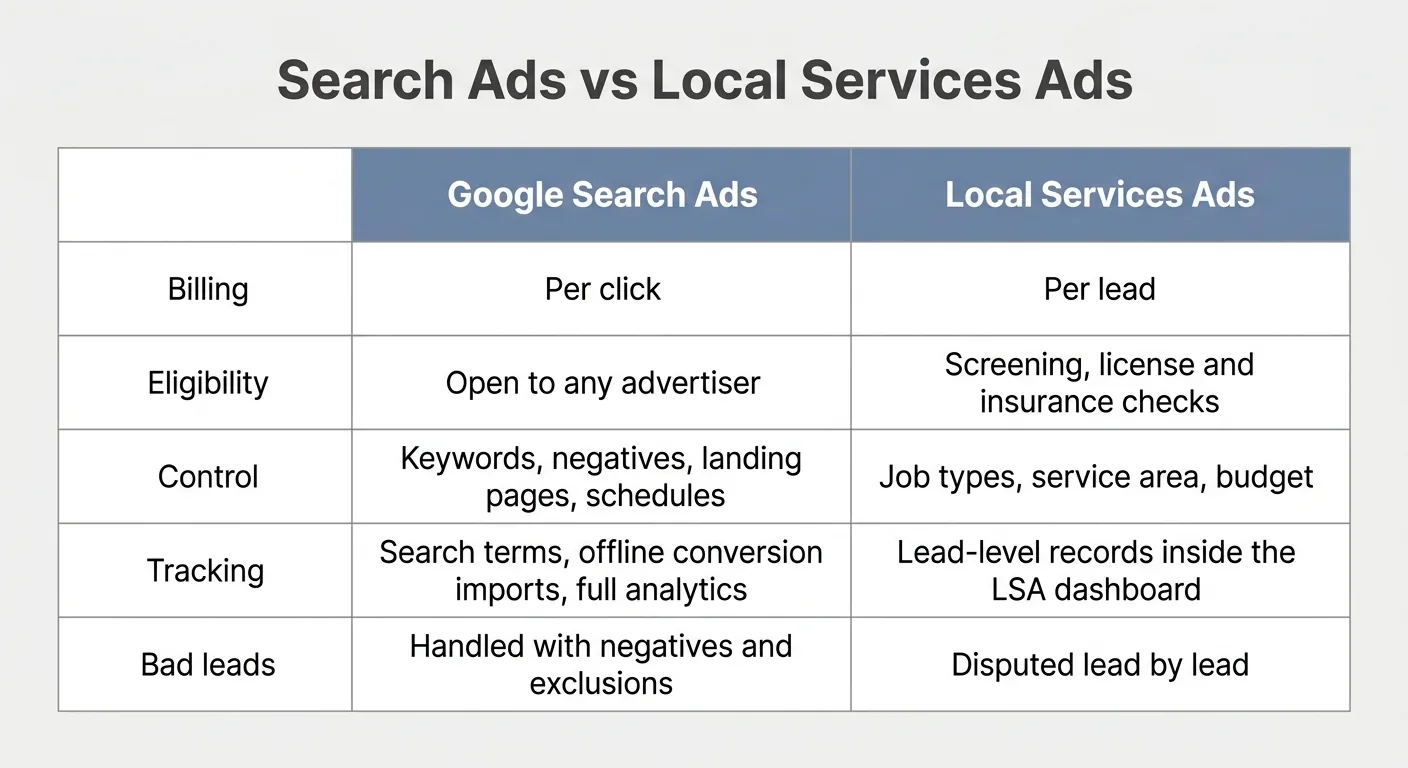
Warning: Lead fraud and junk form fills eat 10% to 20% of raw leads. Deploy negative keywords aggressively (DIY, troubleshooting, parts only). Use phone verification on forms. Monitor LSA disputes and pause underperforming service categories weekly.
Benchmarks by Intent: Emergency Repair vs. Planned Install
Metric | Emergency Repair | Planned Install |
|---|---|---|
Average CPC | $45 | $28 |
CVR (click to lead) | 12% | 10% |
Cost per Lead | $95 | $175 |
Close Rate | 30% | 18% |
Average Ticket | $580 | $6,200 |
Net Profit per Job | $155 | $1,230 |
Emergency repair keywords drive volume but smaller tickets. Install campaigns sacrifice lead quantity for higher-margin jobs. A 13:1 profit becomes reachable when you shift 25% to 30% of spend from repair to install keywords during shoulder seasons and double install bids when outdoor temps spike past 95°F. That’s when aging units fail and homeowners commit fast.
Case Study: Shifting 30% Budget from Repairs to Installs for 13:1 Profit
A Phoenix contractor ran $8,000 monthly on Google Ads, split 80% repair, 20% install. During a July heatwave, they reallocated to 50% repair, 50% install and raised install bids by 60%. Repair spend dropped to $4,000, install climbed to $4,000. Repair leads fell from 95 to 68, but close rate held at 28%, yielding 19 booked jobs at $620 average ($11,780 revenue).
Install leads jumped from 12 to 29. Close rate rose to 21% due to urgency, booking six new AC units at $3,950 average ($23,700 revenue). Total revenue hit $35,480 from $8,000 spend. At blended 30% margin, gross profit was $10,644. Net profit after ad cost: $2,644, or 13.24:1 return on the install side alone.
The key change was tighter geo-targeting to ZIP codes logging the most 911 heat calls, plus landing pages with same-day install messaging and financing callouts.
SEO (Local + Content Hub-and-Spoke): Benchmarks and Compounding ROI
Organic search delivers the highest long-term ROI but requires patience. Expect six to 12 months before traffic and leads reach meaningful volume. Stabilized cost per lead drops below $70 by month 12 and continues falling as rankings compound. Lead quality from SEO typically exceeds PPC because searchers engage multiple pages, read reviews, and self-educate before calling.
Commercial HVAC shops see exceptional results by building topical hubs (“Commercial HVAC Services”) with spoke pages for each service line (chillers, rooftop units, controls, maintenance contracts) and case studies tagged by building type (schools, hospitals, office towers). This structure signals depth to Google and captures decision-makers researching solutions over weeks, not hours.
Expert Note: Property managers and facility directors rarely convert on first visit. They bookmark case studies, download spec sheets, and return multiple times. Hub-and-spoke architecture with trackable PDFs (gated or ungated) lets you capture intent early and nurture through email sequences tied back to booked proposals.
Benchmarks: Share of Bookings, CPL Over Time, Lead Quality
Timeline | CPL | Close Rate | Share of Total Bookings |
|---|---|---|---|
Month 3 | $180 | 22% | 8% |
Month 6 | $105 | 28% | 18% |
Month 12 | $60 | 35% | 32% |
SEO leads close at higher rates because inbound calls reference specific content (“I read your article on duct sealing”) and demonstrate informed intent. By month 12, organic traffic often supplies one-third of booked jobs while costing less per lead than any paid channel. The asset compounds: content published in month six continues driving leads in month 24 with zero incremental spend.
Case Study: Commercial HVAC SEO Adding $1.3M Annual Pipeline
A commercial contractor serving office parks and retail centers started with minimal organic visibility, ranking for their brand name only. First Page Sage built a hub page targeting “commercial HVAC services [city]” and 12 spoke pages covering rooftop unit replacement, chiller maintenance, building automation retrofits, and energy audits. Each spoke included a case study with photos, before-after utility bills, and client testimonials. The firm published two blog posts monthly and earned 15 editorial backlinks from local business journals and chamber sites.
After three months, organic traffic grew 75%. By month six, inquiries from organic search jumped 220%. At the 12-month mark, the site logged 453% more sessions year-over-year and generated 64 qualified commercial leads. Close rate on these leads was 38%, booking 24 projects at an average contract value of $54,200.
Total pipeline value reached $1.3 million. Total SEO investment (content, links, technical work) was $42,000 over 12 months, delivering a first-year ROAS of 31:1. Recurring maintenance agreements added $87,000 in annual contract value, further compounding returns.

Social (Paid + Organic): Benchmarks as an Assist + Remarketing Channel
Social media rarely wins as the last-click attribution channel for hvac marketing, but it plays a role in the assist column. Paid Facebook and Instagram ads work well at retargeting website visitors who didn’t convert and at promoting financing offers for high-ticket installs. Organic posts build trust and showcase completed jobs, but they won’t replace search volume.
Pros: Low cost per impression, granular audience targeting (homeowners 35+, income brackets, ZIP codes), video testimonials perform well.
Cons: Lead quality is softer than search, response speed must be under five minutes to maintain conversion rates, and attribution often blends with other touchpoints.
Audiences that consistently convert include website visitors in the past 30 days, engaged video watchers (75%+ view), and lookalike segments based on past customers. Cold prospecting to broad demographics wastes budget unless paired with a compelling limited-time offer.
Benchmarks: CPM, CTR, Lead Cost, and Assisted ROAS
Audience Type | CPM | CTR | CPL | Close Rate | Assisted ROAS |
|---|---|---|---|---|---|
Cold Prospecting | $18 | 1.4% | $240 | 8% | 2:1 |
Warm Retargeting | $12 | 2.8% | $140 | 18% | 5:1 |
Engaged Video | $10 | 3.2% | $110 | 22% | 6:1 |
Creative format matters. User-generated content (customer testimonials, before-after photos) outperforms stock imagery by 40% on CTR. Short-form videos (15 to 30 seconds) highlighting same-day service or zero-percent financing drive the highest engagement. Carousel ads showcasing multiple services underperform single-offer creative in direct response tests.
Lead quality depends on follow-up speed. Leads older than 10 minutes see close rates drop by half. Use instant SMS confirmations and route social leads to a dedicated line so they don’t sit in a generic inbox.
Case Study: Retargeting Cuts PPC CPL by 22% for New System Deals
A contractor running $6,500 monthly on Google Ads for AC installation keywords added a $2,800 Facebook retargeting campaign aimed at site visitors who viewed the “New AC Systems” page but didn’t submit a quote request. The audience size was 4,200 users over 30 days. Frequency was capped at four impressions per week. The ad featured a limited-time $750 rebate plus 60 months zero-percent financing, linking to a dedicated landing page with an embedded scheduler.
Over 60 days, the retargeting campaign generated 23 quote requests at $122 CPL. Close rate was 26%, booking six installs at $4,100 average. Revenue from retargeting alone was $24,600. Meanwhile, the Google Ads CPL for the same keyword set dropped from $195 to $152 because fewer prospects needed multiple search clicks (they converted after seeing the Facebook reminder).
Blended CPL across both channels fell 22%, and total installs increased from nine to 15 in the test period. The key was tight audience segmentation and a financing hook that addressed the main objection (upfront cost).
Comparison Table: Channel-by-Channel ROI Snapshot
Channel | CPL Range | CVR | Close Rate | Avg Order | Payback (Months) | ROAS |
|---|---|---|---|---|---|---|
Direct Mail | $40–$110 | N/A | 15–30% | $1,400–$8,800 | 1–3 | 4:1–13:1 |
PPC (Repair) | $85–$150 | 10–15% | 25–35% | $580–$750 | 1–2 | 6:1–9:1 |
PPC (Install) | $120–$210 | 8–12% | 15–22% | $3,950–$6,200 | 1–2 | 9:1–13:1 |
SEO (Organic) | $40–$180* | 12–18% | 30–40% | $1,100–$5,400 | 6–12 | 10:1–31:1 |
Social (Cold) | $180–$280 | 8–12% | 8–12% | $3,200–$4,800 | 3–6 | 2:1–4:1 |
Social (Warm) | $110–$160 | 12–18% | 16–24% | $3,500–$5,000 | 2–4 | 5:1–6:1 |
SEO CPL decreases over time; $180 at month 3, $60 by month 12.
Caveats: Market size, brand strength, and operational capacity affect these ranges. A shop with five-star reviews and a three-week backlog will see better close rates. A new entrant in a saturated market will trend toward the low end. All ROAS figures assume 25% to 40% gross margin and exclude fixed overhead.
Budget Allocation by Stage and Season
Use these benchmark-driven splits to translate data into action. Adjust monthly as booking rates and capacity shift.
0–3 Techs or New Market Entry
Focus on fast-payback channels with minimal lead time. Allocate 50% to Google Local Services Ads and emergency repair keywords. Reserve 30% for local SEO foundations (Google Business Profile optimization, review generation, on-page basics). Dedicate 15% to direct mail in your tightest service radius (aging systems only). Hold 5% for retargeting social ads once you have 500+ site visitors monthly.
Example split: $1,000 total becomes $500 LSA/PPC, $300 SEO/GBP, $150 direct mail, $50 social retargeting. Prioritize booking rate over volume. If you can’t handle more than 20 leads weekly, throttle spend to avoid wasted inquiries and reputation damage from slow response.
4–15 Techs, Dominant Residential
Shift toward a balanced mix with seasonal flex. Allocate 40% to PPC (split 60% repair, 40% install), 30% to SEO and content (blog, service pages, video), 20% to direct mail (two drops annually in shoulder seasons), and 10% to social retargeting and engagement.
During peak heat or cold snaps, increase PPC to 50% and reduce direct mail to 10%. In shoulder months (April, May, September, October), flip the script: 35% PPC, 30% direct mail for install offers, 25% SEO, 10% social. Track booking capacity weekly. If close rate dips below 20%, pause spend on the lowest-converting source until you clear the pipeline.
Commercial-Leaning Firms
Bias heavily toward SEO and content because commercial buyers research for weeks. Allocate 50% to hub-and-spoke content, case studies, and backlink outreach. Dedicate 25% to targeted PPC (branded + high-intent commercial keywords like “office building HVAC retrofit”). Reserve 15% for account-based social ads (LinkedIn or Facebook targeting facility managers, property management firms). Hold 10% for direct mail to multi-tenant building owners using scraped property records.
Commercial cycles are long. Expect three to six months from first touch to signed proposal. Build email nurture sequences, gate spec sheets or energy audit guides, and track multi-touch attribution in your CRM. ROI won’t show in month one, but LTV per commercial client often exceeds $50,000 over 36 months.

Tracking and Proving ROAS for Offline + Online
Attribution is where most hvac marketing plans fall apart. Calls come in, jobs get booked, but nobody ties revenue back to the source. Without tracking, you can’t prove ROI or scale winners.
Offline Attribution Tactics That Actually Work
Dynamic call tracking: Assign unique phone numbers to each postcard batch, Valpak zone, vehicle wrap, or sponsorship. Swap the number on your landing pages by UTM source so PPC, SEO, and social each get distinct digits.
Unique URLs and QR codes: Print short, memorable URLs (yourshop.com/spring or yourshop.com/valpak) on every mail piece. QR codes work if the landing page auto-captures the scan source in a hidden form field.
Offer codes: Give each campaign a code (SAVE50, INSTALL500) and train dispatchers to ask, “How did you hear about us? Did you have a special offer code?” Log it in your CRM or service software.
Dispatcher scripts: Standardize intake questions. “Which number did you call?” or “Did you receive our postcard?” Surface attribution at first contact.
Reconcile booked revenue to source weekly in your CRM. If a lead came from Valpak’s tracked number and the job closed at $4,200, tag that revenue to the direct mail channel. Roll up monthly to calculate true ROAS.
Pipeline Quality Metrics That Matter
Stop reporting clicks and impressions to your CFO. They don’t pay the bills. Track booked jobs by source, average ticket by channel, gross margin per lead source, cancellation rate (no-shows, declined quotes), and repeat rate over 12 months.
True ROAS is calculated at the job level: (Gross Revenue from Channel × Gross Margin %) ÷ Channel Spend. For example, 30 jobs from SEO at $1,800 average and 35% margin yields $18,900 profit. If you spent $3,200 on content and links that month, ROAS is $18,900 ÷ $3,200, or 5.9:1. Repeat monthly and track the trend. If a channel’s margin or repeat rate is falling, look into lead quality and follow-up speed before pouring in more budget.
Common Mistakes That Kill HVAC ROI
Ignoring multi-touch attribution. A prospect sees your postcard, Googles your name, clicks a PPC ad, then calls. Which channel gets credit? Without call tracking and UTM parameters, you’ll under-invest in the true driver.
Running identical offers across all channels. Emergency repair PPC needs “same-day service” messaging. Install direct mail wins with rebate dollar amounts. One-size-fits-all creative underperforms by 30%.
Chasing raw lead volume over close rate. Fifty leads at 10% close (five jobs) loses to 25 leads at 30% close (seven jobs). Optimize for booked revenue, not vanity metrics.
Neglecting negative keywords and geo-fences. Broad match on “HVAC” pulls DIY searchers and out-of-territory clicks. Waste 20% of PPC budget on junk if you skip this hygiene.
No follow-up SOP for speed-to-contact. Leads older than 10 minutes convert at half the rate. If your dispatcher is part-time or your form goes to a generic inbox, you’re bleeding margin.
Underestimating SEO time-to-value. Expecting month-one ROI from organic content kills the channel before it compounds. Budget for six months minimum and measure incremental lift, not overnight wins.
Forgetting to test and kill losers. Run two ZIP codes for direct mail, two ad groups for PPC, two content topics for SEO. After 60 days, double down on the winner and cut the loser. Rinse and repeat.
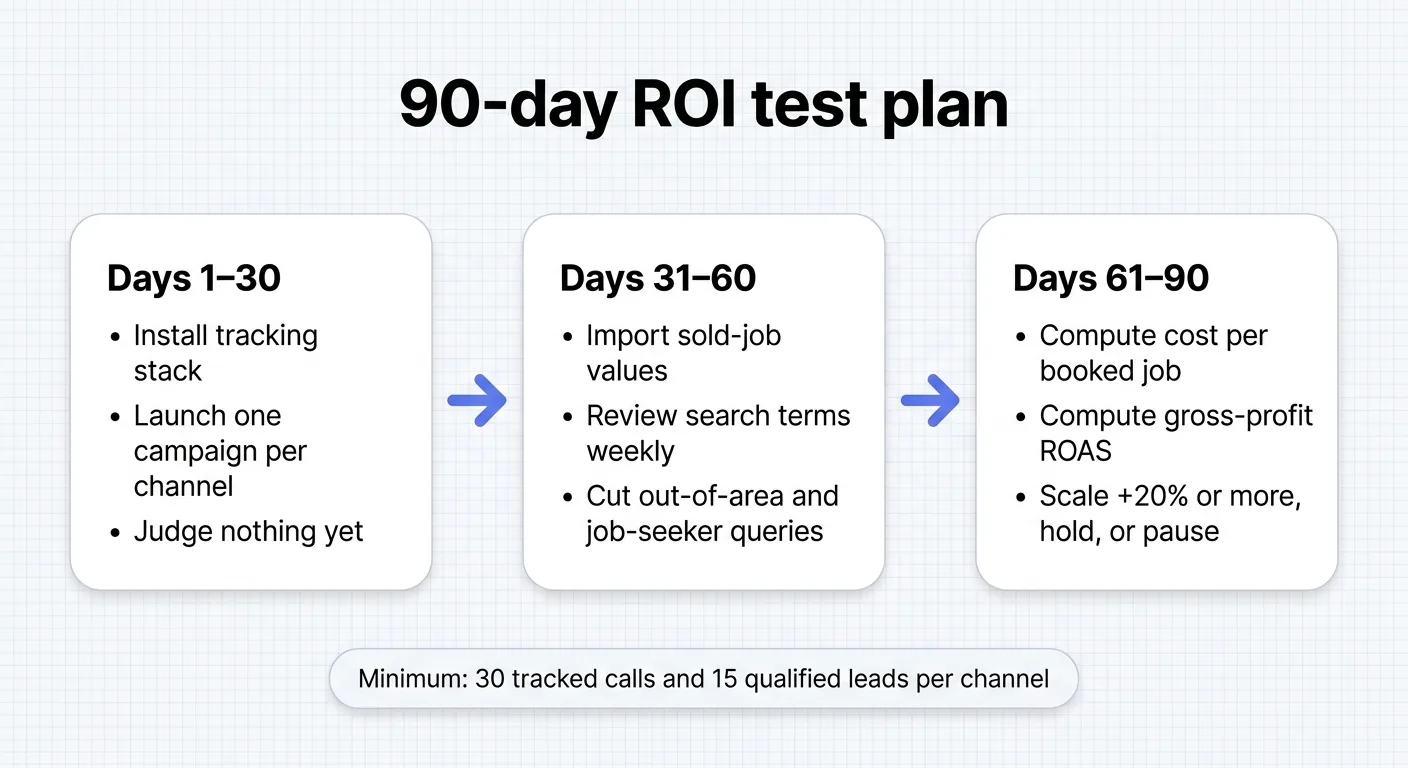
90-Day Validation Plan Using These Benchmarks
Week 1–2: Pick two channels to test (PPC install keywords + direct mail in one ZIP, for example). Set guardrail CPL targets based on the benchmarks above. For PPC installs, cap at $180 CPL. For direct mail, cap at $90.
Week 3–6: Launch campaigns with call tracking and unique URLs. Log every lead source in your CRM. Track leads, booked jobs, and revenue weekly.
Week 7–8: Calculate interim ROAS. If PPC is at $160 CPL and 18% close rate with $5,200 average ticket, you’re profitable. If direct mail is at $110 CPL and 12% close, pause and adjust the offer or list.
Week 9–12: Scale the winner by 30% to 50%. Cut or pivot the underperformer. Document what worked (geo, offer, creative) and replicate in adjacent markets or seasons.
Quick-win: Start with Google Local Services Ads if you have zero tracking in place. LSA provides built-in lead details and dispute tools, giving you attribution on day one. Pair it with a $200 test budget and a five-minute dispatcher script to capture source. You’ll have proof of ROI within two weeks.
Sources and Data Notes
Data and case studies were drawn from Valpak’s residential ROI white paper (Q2 2023), PostcardMania’s 34-campaign compilation (2022–2024), WebRunner Media’s heat-wave PPC test (July 2023 Phoenix market), Mediagistic’s Yelp Ads performance analysis for Tucson contractors (2023), First Page Sage’s commercial HVAC SEO case study (12-month results through March 2024), Blue Corona’s installation budget-shift experiment (2023), and Marketing 360’s social retargeting pilot (Q1 2024). Google Local Services Ads benchmarks come from Google’s official LSA documentation and agency reporting through December 2024.
All revenue and margin assumptions reflect typical residential service shops with 25% to 40% gross margins. Commercial margins vary widely by contract type. Seasonal peaks and geographic cost-per-click data are indexed to Sun Belt and Mid-Atlantic markets (adjust for local competition). Figures are presented as ranges to account for variance in brand strength, review ratings, and operational capacity.
Frequently Asked Questions
What is the average ROAS for HVAC direct mail campaigns like Valpak or PostcardMania?
Expect 4:1 to 13:1 return on ad spend when you mail to ZIP codes with older systems and use a tracked phone number or offer code. The high end (13:1) occurs when you target 15+ year-old HVAC units with a $500 install rebate. List quality and offer clarity drive the spread.
How do I calculate true ROI for HVAC PPC during peak heat seasons?
Multiply gross revenue from jobs attributed to PPC by your gross margin percentage, then divide by total ad spend. During heat waves, raise install bids by 40% to 60% and tighten geo-targeting to ZIP codes with the highest AC failure rates. Track profit per job, not just CPL, because urgency lifts close rates and ticket sizes.
Are there case studies showing HVAC social media ads driving $3,950 AC unit sales in slow periods?
Yes. Retargeting campaigns that show financing offers to past site visitors convert at 16% to 24% close rates. Pair a limited-time rebate with zero-percent financing messaging and route leads to a dedicated fast-response line. Social works best as an assist channel, not a standalone driver.
What are Yelp ads ROI benchmarks for competitive AC markets like Tucson?
Mediagistic reported a 43% reduction in CPL when Yelp ads were optimized with negative keywords and tighter service-area targeting. Expect $90 to $160 CPL with 20% to 28% close rates if your Yelp profile has 4.5+ stars and responds to reviews within 24 hours.
Which commercial HVAC SEO strategies yield $1.3M annual revenue for contractors?
Build a topical hub page for “Commercial HVAC Services” with spoke pages for each offering (chillers, rooftop units, controls). Add case studies tagged by building type and earn 15+ editorial backlinks from local business publications. Expect six to 12 months to see meaningful lead volume, with 38% close rates on organic inquiries.
What are the best tracked offers for HVAC postcards: $50 off repair vs. $500 off new unit?
For repair-focused shops, $50 to $79 off any service call drives 0.8% to 1.5% response. For install campaigns, $500 off a new system plus a free efficiency audit pulls 1.2% to 2.5% response in ZIP codes with aging equipment. Always pair the offer with a unique phone number or URL.
How do I build a 90-day HVAC marketing roadmap from $1,000 to $8,000 monthly budgets with CPL targets?
Start with 50% Local Services Ads, 30% local SEO, 15% direct mail, 5% social. Set CPL guardrails at $150 for LSA, $180 for installs, $90 for mail. Scale the channel hitting target close rate by 30% to 50% each month. Once SEO drives 10+ organic leads monthly, shift 10% from LSA to content and backlinks.
How does shifting PPC from repairs to installs drive 453% organic traffic growth?
The 453% figure comes from an SEO case, not PPC. That said, reallocating 30% of PPC spend from repair keywords to install keywords during peak seasons raises profit per dollar from 9:1 to 13.24:1 because install tickets are larger and close rates spike when units fail in extreme weather.
Ready to track every dollar and scale what works? Sure Shot Systems helps HVAC contractors connect marketing spend to booked revenue with bulletproof attribution and pipeline dashboards. See exactly which channels deliver profit, not just leads.
About the Author
Ben Desjardins founded Sure Shot Systems after two decades of watching local contractors overpay for leads and underinvest in owned channels that compound ROI. As a published author and three-time founder, he's built his reputation on one core principle: measure everything, optimize relentlessly, and prove marketing ROI in dollars booked, not impressions generated.
Sure Shot Systems specializes in the exact attribution frameworks detailed in this guide: call tracking integration, CRM lead source tagging, offline conversion imports, and cohort analysis that separates high-margin channels from budget drains. Ben's clients span HVAC, roofing, painting, and home services, and they share a common profile: they're tired of agencies that hide behind vague reports and demand what Sure Shot delivers: direct access to senior strategists, transparent reporting, and campaigns that pay for themselves in the first 30 days.
Ben's approach rejects the agency status quo, junior account managers and 12-month lock-ins. Sure Shot Systems earns your business every billing cycle with month-to-month engagements through measurable lead quality, documented close rates, and acquisition costs that beat lead marketplaces by 80% or more. His case studies and benchmark data have guided hundreds of contractors toward marketing strategies that scale profit over lead volume. Follow Ben on LinkedIn.
Got a question?
Send us a message. We're happy to help.