
Search your best keyword from your office and you'll probably like what you see. Google personalizes results by location down to the neighborhood, and you're standing in the one place on earth where your business is most likely to rank #1: your own address.
Your customers are not standing there. They're searching from a kitchen six miles away, and the results they see can be completely different. That gap - between the ranking you see and the ranking your market sees - is where local businesses quietly lose jobs every week.
This article covers what local rank tracking should look like in 2026: why single checks mislead you, what a Map Pack grid actually reveals, why AI Overview citations became a number worth watching, and what to review each week.
One rank check is one pixel of the picture
A local ranking is not one number. It's a different number for every combination of three things: the keyword, the searcher's location, and the surface Google shows them on.
Take a plumber serving eight cities. Six services across eight cities is 48 keyword-location combinations before you count variations. Checking one of them from one spot covers about 2% of the picture. The other 98% is where your competitors are winning without you noticing.
Distance is the reason. Proximity is one of the strongest local ranking factors, especially in the Map Pack. A business ranked #1 at its front door routinely drops out of the pack entirely four miles away. If your service area spans a county, your visibility is a gradient, and you need to see the whole gradient to know where to work.
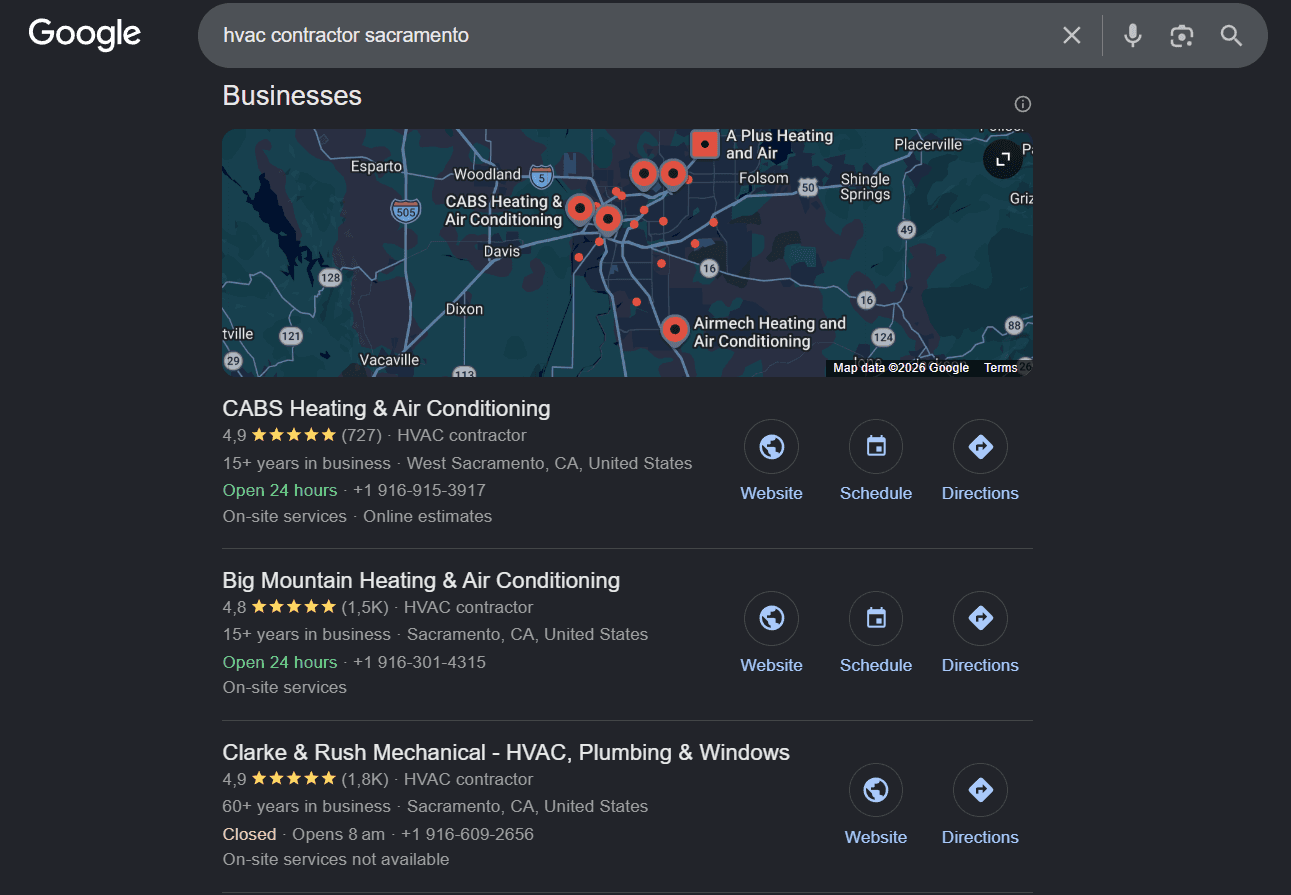
What a Map Pack grid shows that a rank checker can't
A Map Pack grid runs real searches from a grid of coordinates across your service area - 25 points per region, for example - and records where you rank in the local pack at each point. The result is a map of pins: green where you're in the 3-pack, orange where you're close, red or gray where you're invisible.
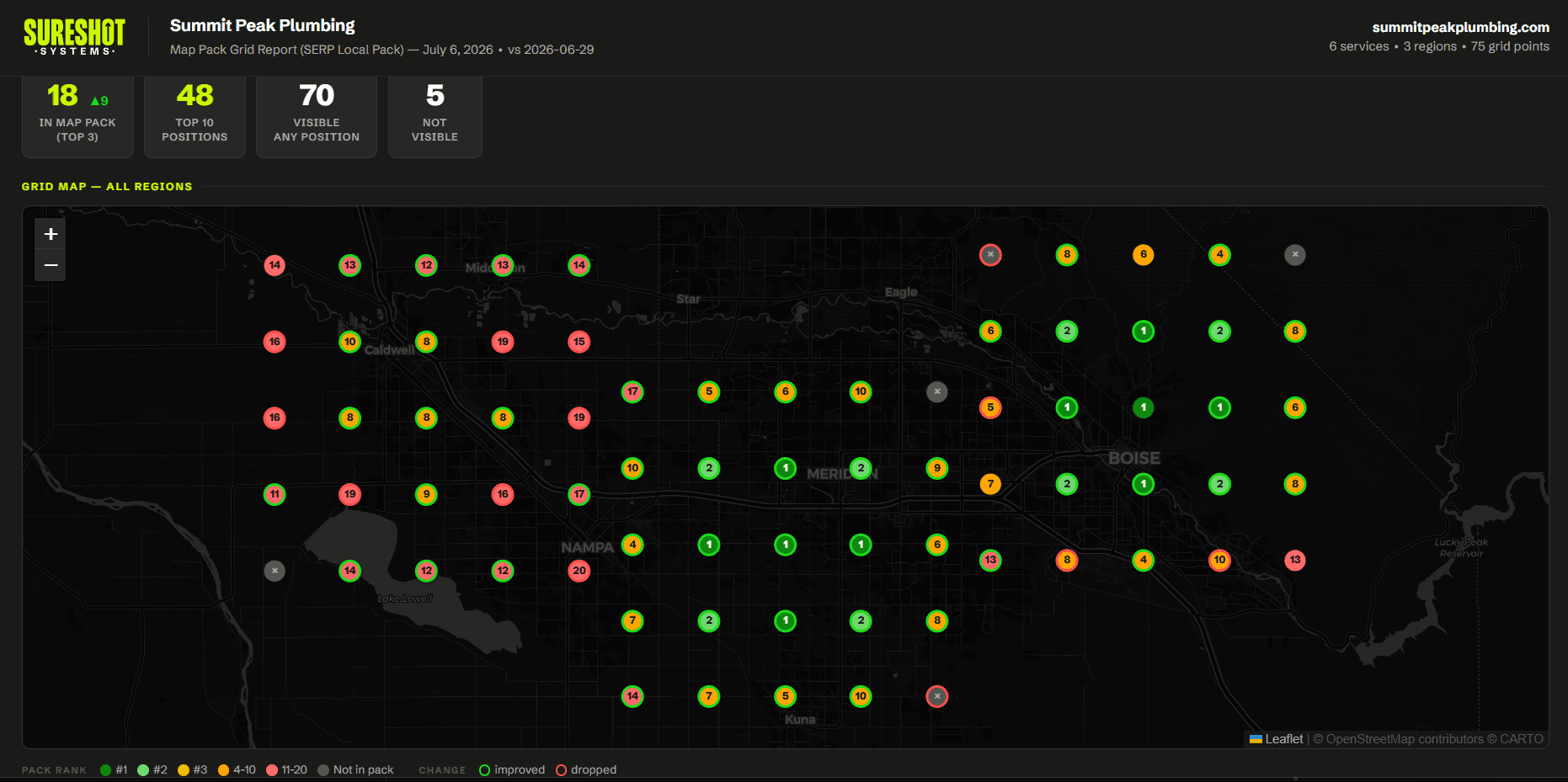
Two things happen when business owners see their first grid. First, the "we rank #1" story dies, because the map shows exactly where that's true and where it isn't. Second, the to-do list writes itself. A cluster of orange pins around one suburb is a specific, fixable problem: reviews that mention that city, a service page for it, service-area settings on the Business Profile. A red zone across a whole region tells you where your next location page belongs.
Week over week, the grid becomes a progress report. Pins that flip from orange to green after a review push are proof the work moved the needle. That's the difference between tracking and reporting: a grid you check once is trivia, a grid you compare weekly is a management tool.
AI Overviews: the surface almost nobody measures
Google now answers many local searches with an AI-generated summary above everything else, and those answers cite a handful of sources. Roughly 60% of searches end without a click, as AI-generated answers satisfy them on the results page (Forbes, April 2025). When the AI answer names two of your competitors and a directory, the customer may make a shortlist before your #1 organic ranking ever loads.
We wrote about optimizing for this in our GEO guide and the AI Visibility Boost exists to fix it. But you can't manage what you don't measure, and almost no rank tracker reports it. The number to watch is citation share: of the money keywords in your market that trigger an AI Overview, how many cite you? Zero is the normal starting point. The businesses that move it first get a surface with almost no competition on it.
The four numbers to review weekly
If you track local visibility seriously in 2026, four numbers cover it.
Organic positions for every service-plus-city page you have, plotted on a map, with week-over-week movement. Pages sitting at positions 4 through 10 are your cheapest wins.
Map Pack presence as grid points in the 3-pack, per region. Watch the count, and watch which zones flip.
AI Overview citation share, plus the names of whoever is getting cited instead of you.
The trend of all three. Direction matters more than any single week.
Then turn the numbers into three tasks. Not ten - three, ranked by impact. A page at #5 that needs one internal link. A grid zone where five reviews would tip you into the pack. An AI answer citing a competitor you outrank organically. Tracking that doesn't end in a short task list is just scorekeeping.
Do it yourself, or have it land in your inbox
You can build a version of this manually: search from different locations with a VPN or a rank-checking tool, keep a spreadsheet, screenshot AI answers for your keywords, review it monthly. It works, and for a single-location business with a tight service area it may be enough. The honest cost is a few hours a month, every month, forever.
We built the Local Rank Tracker because neither we nor our clients wanted to spend those hours. It checks every service and city weekly, runs the Map Pack grid from real coordinates, tracks AI Overview citations on every money keyword, and closes each report with the top 3 actions in one email. There's a live sample report you can open right now to see exactly what it looks like.
Either way, stop judging your visibility from your own driveway. Your market can't see it from there.
FAQ
What is local rank tracking?
Local rank tracking measures how your business ranks across different locations, keywords, and Google search surfaces. Instead of relying on a single ranking, it shows the visibility your actual customers see throughout your service area.
Why isn't one rank check enough?
A single rank check only shows how you rank from one location. Because local rankings change based on proximity, search intent, and search features, businesses can rank highly in one area and poorly just a few miles away.
What is a Map Pack grid?
A Map Pack grid runs searches from multiple points across your service area and maps the results. It shows exactly where your business appears in Google's local 3-pack and where competitors are outperforming you.
What should I track besides rankings?
The most important local SEO metrics in 2026 are organic rankings, Map Pack visibility, AI Overview citation share, and week-over-week trends. Together, these metrics provide a more complete picture of local search visibility.
What is AI Overview citation share?
AI Overview citation share measures how often your business is referenced in Google's AI-generated answers. It helps you understand whether your brand is being surfaced when customers search for services in your market.
Why do AI Overview citations matter?
AI Overview citations can influence customer decisions before they visit a website. If Google's AI mentions competitors instead of your business, potential customers may narrow their options before viewing traditional search results.
How often should I review local ranking data?
Weekly reviews are usually enough for most local businesses. Tracking rankings, Map Pack visibility, and AI citations every week makes it easier to spot trends, measure SEO progress, and prioritize the next actions.
How can I improve weak areas in my service area?
Improving weak areas typically involves creating location-specific content, earning reviews from customers in those locations, strengthening your Google Business Profile, and addressing gaps revealed by Map Pack grid data.


Got a question?
Send us a message. We're happy to help.