
If you manage hundreds of service-city landing pages and track rankings across multiple zip codes, you already know the problem. Local Falcon built the geo-grid category, and its heat maps are still the clearest way to see Map Pack visibility at a glance. But credit-based scanning gets expensive at scale, and a grid scan alone does not tell you what to do next.
Agencies running programmatic local SEO need a local rank tracker that handles bulk keywords, covers organic results alongside the Map Pack, and delivers a finished report instead of another dashboard to operate. This guide compares the alternatives to Local Falcon worth considering in 2026, including where each one fits and where it falls short.

Why agencies outgrow Local Falcon for programmatic pages
Local Falcon does one thing well: geo-grid visualization of Map Pack rankings. You pick a keyword, set a grid size, and see where your Google Business Profile ranks at each point. That workflow works for a single location with a handful of keywords. It breaks down when you are tracking 200 service-city pages across 15 markets.
Three friction points push agencies toward alternatives:
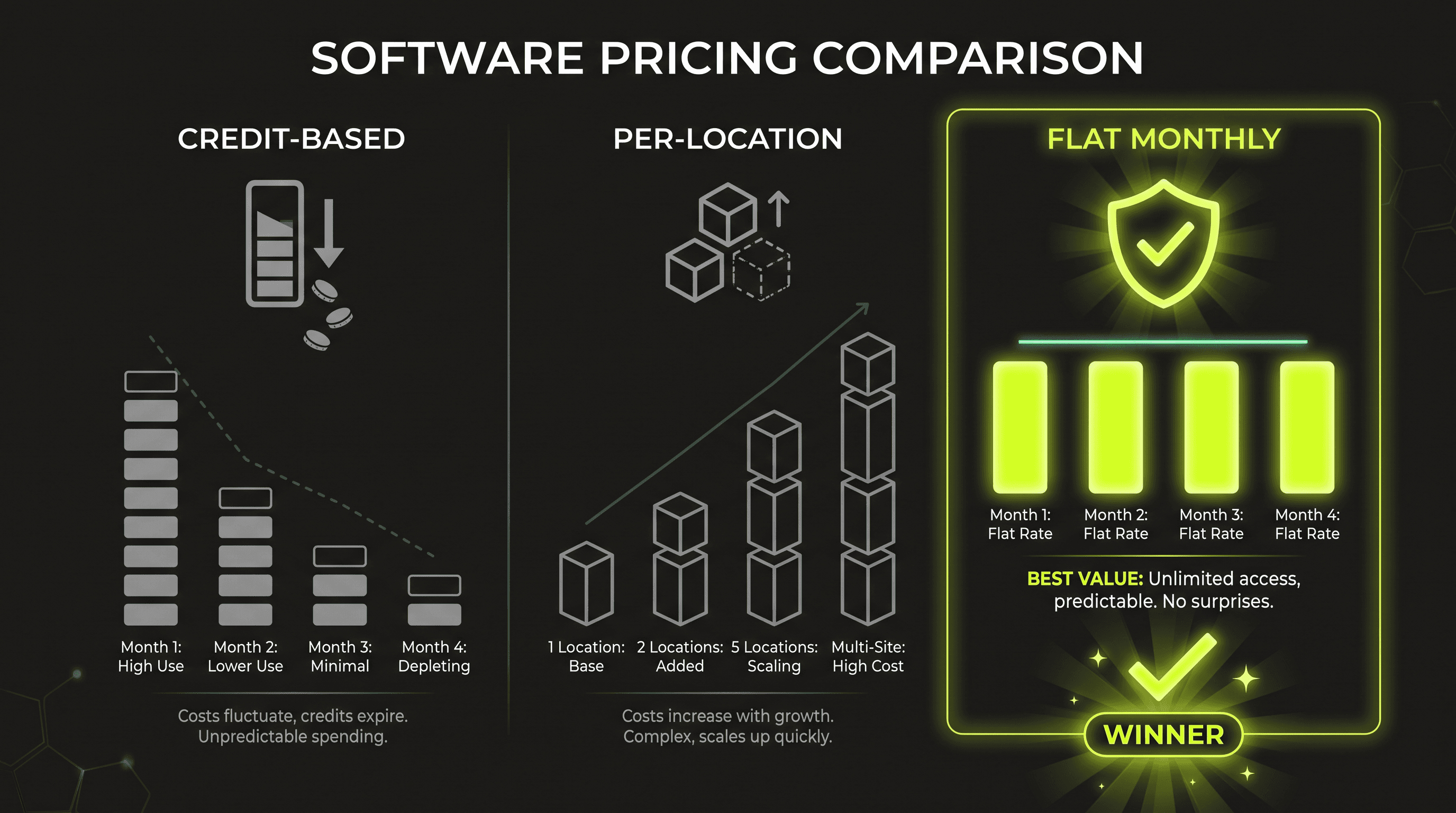
Credit math stops working at scale. Local Falcon charges per scan. Track 20 keywords across 10 locations weekly, and monthly costs climb fast. For agencies billing clients on flat retainers, unpredictable scanning costs eat into margin.
Grid data is only one piece of local visibility. A business can rank #1 in the Map Pack grid but sit on page 3 for organic "drywall repair in bakersfield" searches. It might be absent from Google's AI Overview answers entirely. A complete picture requires organic rankings, Map Pack position, AI citation tracking, and ad pressure data in one view.
Reports still require assembly. Exporting grid data, cross-referencing it with organic rankings from another tool, writing up action items, and formatting a client-ready report takes hours per account. That labor cost often exceeds the software subscription.
The alternatives below address these gaps differently. Some go broader (BrightLocal), some go deeper on GBP management (Local Viking), and one is built specifically around the weekly report-and-action cycle (Sure Shot Systems Local Rank Tracker).
What is the best SEO rank tracker for local agencies?
The short answer: it depends on what you are solving for. If you need a broad local SEO suite with citations and reviews, BrightLocal is hard to beat. If you want GBP management alongside grid tracking, Local Viking covers both. If the problem is report assembly time and proving that last week's work moved the needle, Sure Shot Systems Local Rank Tracker was built for that specific job.
Here is how the main options stack up for agency use cases.
Sure Shot Systems Local Rank Tracker
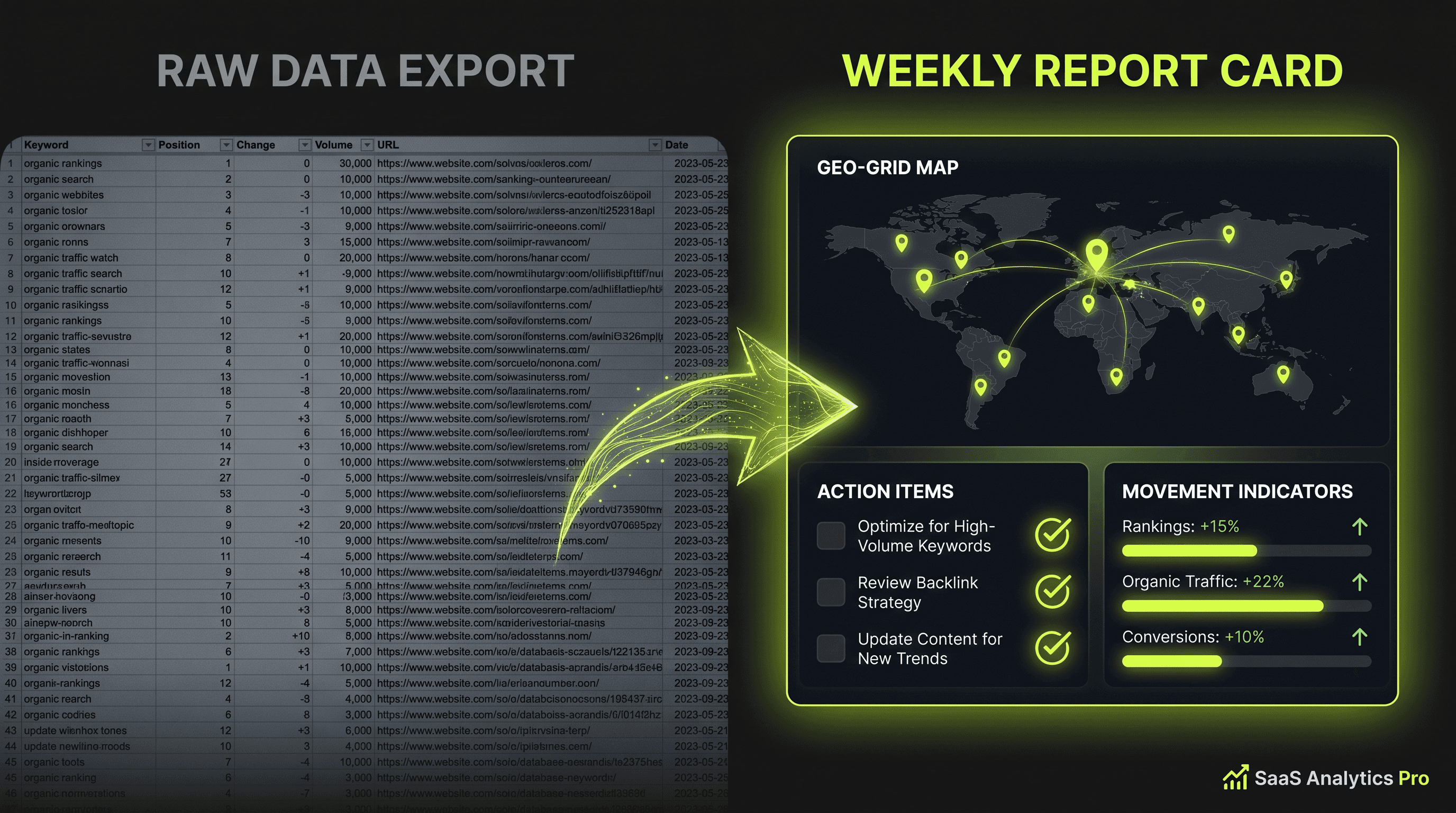
Sure Shot Systems Local Rank Tracker takes a different approach from every other tool on this list. It is not a scanning console or a dashboard you log into daily. It is a managed weekly reporting system that delivers a finished, client-ready report covering organic rankings, Map Pack geo-grid, Google AI Overview citations, ad pressure, and a prioritized list of what to fix next.
What makes it different for programmatic pages:
The report maps organic rankings by service and city, with week-over-week movement. If you run 300 service-city landing pages, the report shows which ones are climbing, which dropped, and which are stuck. The Map Pack grid shows geo-grid positions with movement rings at each point, along with competitor names, star ratings, and review counts.
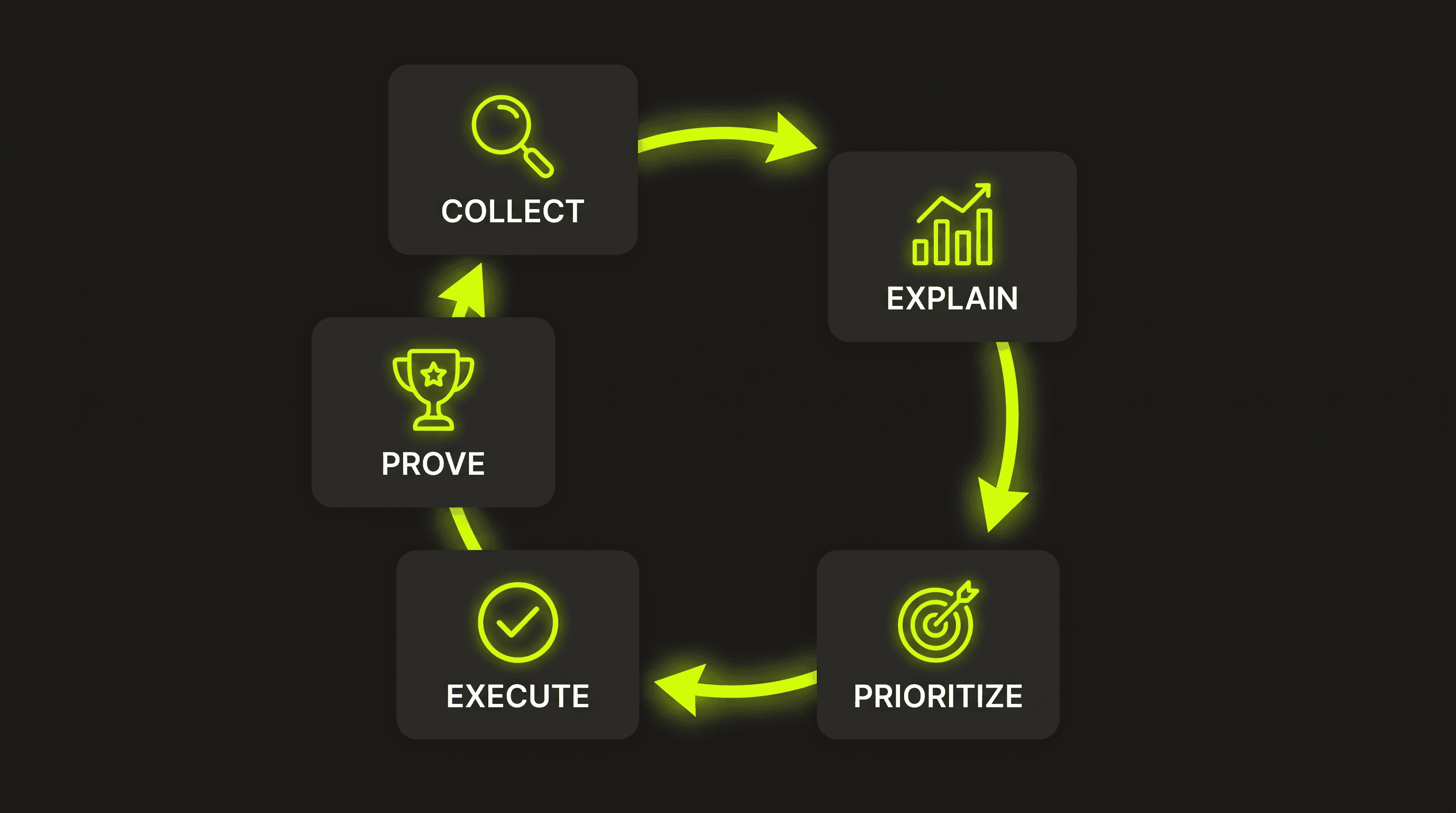
The standout feature is the Top 3 Actions section. Each report identifies three prioritized tasks based on the data - things like "add FAQ schema to bakersfield drywall page" or "build internal links from your roofing pillar to these 4 city pages." You mark a task done with one click. The following week's report measures whether those exact keywords improved, printing "improved," "no movement yet," or "declined."
That prove-it loop is the core trust mechanism. Clients see the recommendation, the completion, and the measured result in one document. No other tool in this comparison automates that cycle.
Pricing and packaging:
Solo: $99/month per business - one market, full weekly reports
Pro: $249/month per business - large service areas, multi-city tracking, built for programmatic page structures
Agency: $499/month - five Pro-level client slots with your logo and branding. Additional slots are $79/month each
Agency pilot: $99/month - one white-labeled client slot to test before committing
All plans are month-to-month. No annual lock-in required, though annual billing gets two months free.
Free entry point: You can get a free snapshot report delivered to your inbox in about 60 seconds. No credit card, no sales call. The snapshot shows enough of the data to evaluate whether the full weekly product is worth the subscription.
White-label for agencies: The agency demo shows what the branded report looks like with your logo and colors. Reports arrive by email on a set schedule. Clients open a bookmarkable, no-login dashboard with trends and report history.
60-day prove-it guarantee: Complete the Top 3 actions each week and mark them done. If 60 days of completed tasks produce no measured keyword movement, Sure Shot refunds those 60 days.
⚠️ Where it falls short: Sure Shot is not a citation builder, review management platform, backlink database, or general keyword research suite. It does not offer ad-hoc scanning or variable grid sizes. If you want a self-serve console where you run grids on demand, Local Falcon or BrightLocal will fit better. Sure Shot is built for the agency or business owner who wants a finished report delivered on schedule with clear next steps - not another tool to operate.
How do you check local SEO rankings across multiple locations?
Local search results change based on the searcher's physical location. Someone standing next to your office sees different Map Pack results than someone 5 miles away. Searching from your desk gives you a misleading picture of how visible you are across your service area.
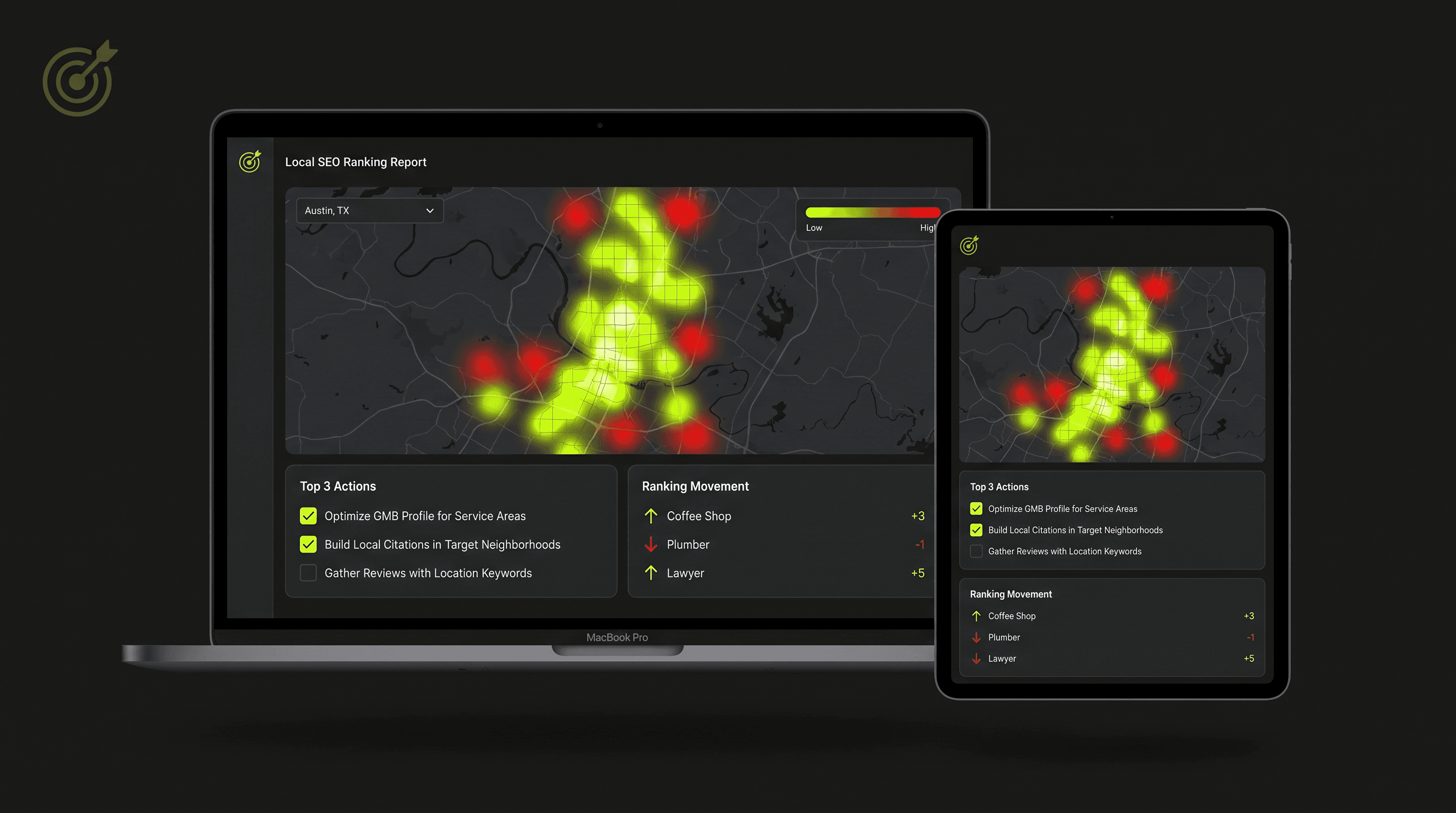
Geo-grid rank tracking solves this. The tool runs searches from a grid of GPS coordinates covering your service area, recording where your business appears at each point. A 13x13 grid, for example, places 169 virtual search points across a defined radius. The result is a heat map showing exactly where you rank strong and where you disappear.
Most tools in this comparison offer some form of geo-grid tracking. The differences come down to grid density, how many keywords you can track per location, and what else gets measured alongside the grid.
Local Falcon
Local Falcon remains the benchmark for geo-grid visualization. The heat maps are clean, intuitive, and immediately understandable to clients who have never seen SEO data before. You configure a grid (up to 169 points), pick your keywords, and run the scan.
Strengths: The visual output is the best in the category. Local Falcon also tracks AI visibility across generative search results, offers automated scan scheduling, and provides white-label reporting at higher tiers. If geo-grid depth is your primary need and you run scans selectively, it delivers clear value.
Limitations for programmatic SEO: The credit-based model means cost scales linearly with volume. Tracking 30 keywords across 20 locations weekly requires significant credit spend. Bulk URL importing and automated keyword-to-location mapping are not built into the core workflow. Reports focus on grid data - organic rankings, AI citations, and ad pressure data require separate tools or manual cross-referencing.
Best for: Single-location businesses and agencies running fewer than 10 client accounts who prioritize visual Map Pack reporting and are willing to manage credit budgets.
BrightLocal
BrightLocal bundles rank tracking with citations, review monitoring, GBP audits, and a Local Search Grid module. It is the broadest suite in this comparison, which makes it attractive for agencies selling full local SEO retainers rather than standalone rank tracking.
Strengths: The Local Search Grid offers geo-grid tracking comparable to Local Falcon. White-label PDF reports can be customized and scheduled for automated delivery. AI Insights adds an analytical layer on top of the raw data. The API supports bulk location imports and rank check triggers, which fits programmatic workflows better than manual grid setup. Citation management and review monitoring mean fewer separate subscriptions.
Limitations: Per-location pricing ($31-$41 monthly depending on tier) adds up when you manage 50+ locations. The platform covers many features at moderate depth rather than going deep on any single one. Setting up the programmatic integration pipeline requires orchestration work.
Best for: Agencies selling comprehensive local SEO packages (citations + reviews + rankings) who need everything in one login and can absorb per-location costs across client retainers.
Local Viking
Local Viking positions itself as a GBP management platform that includes geo-grid rank tracking. You manage Google Business Profile posts, photos, Q&A, and categories alongside grid-based rank monitoring.
Strengths: If GBP optimization is central to your service offering, Local Viking puts management and measurement in one place. You post content, update profile attributes, and then check whether those changes moved the grid. The geo-grid tracking is solid, and pricing is generally lower than BrightLocal for pure tracking use cases.
Limitations: The product is heavier on GBP management than rank intelligence. Organic keyword tracking, AI citation monitoring, and ad pressure analysis are not core features.
Best for: Agencies and consultants whose primary work is GBP optimization and who want grid tracking integrated into that management workflow.
Whitespark
Whitespark built its reputation on citation management and local business data quality. The Local Rank Tracker module adds geo-grid tracking starting at $10/month for basic grids.
Strengths: Citation discovery and NAP consistency auditing are best-in-class. If you are deploying programmatic pages that pull location data from a master spreadsheet, Whitespark can verify that your NAP details match what appears across directories. Clean citation data directly supports better rankings.
Limitations: Rank tracking is a secondary feature, not the main product. Grid density and keyword limits are more restricted than dedicated trackers. White-label reporting and automated delivery are less developed.
Best for: Agencies handling citation cleanup and local data audits who want basic rank tracking without subscribing to a separate tool.
Local Dominator
Local Dominator markets itself as the best overall Local Falcon alternative. It offers geo-grid tracking, AI visibility monitoring, and tools targeting both businesses and agencies.
Strengths: Competitive pricing with a feature set that covers the basics well. Grid tracking, rank monitoring, and a cleaner interface than some older tools.
Limitations: Smaller user base and less third-party integration documentation compared to BrightLocal or Local Falcon. API and automation capabilities are still developing.
Best for: Budget-conscious agencies looking for core grid tracking without the credit model or the higher cost of a full suite.
Head-to-head comparison
Feature | Sure Shot LRT | Local Falcon | BrightLocal | Local Viking | Whitespark | Local Dominator |
|---|---|---|---|---|---|---|
Map Pack geo-grid | Yes, with movement rings | Yes, up to 169-point | Yes (Local Search Grid) | Yes | Yes (basic) | Yes |
Organic rank tracking | Yes, by service + city | Map Pack focused | Yes | Limited | Yes | Limited |
AI citation tracking | Yes (AI Overview + AI Mode) | Yes | AI Insights module | No | No | Yes |
Ad pressure monitoring | Yes | No | No | No | No | No |
Prioritized actions | Top 3 per report + prove-it | AI recommendations | No | No | No | No |
White-label reports | Yes, agency branding | Yes (enterprise tier) | Yes (customizable PDF) | Limited | Limited | Yes |
Report delivery | Automated weekly email | Manual or scheduled | Automated PDF | Manual | Manual | Scheduled |
Pricing model | Flat monthly ($99-$499) | Credit-based (per scan) | Per location ($31-$41/mo) | Subscription tiers | From $10/mo (grids) | Subscription tiers |
Prove-it measurement | Yes (automated) | No | No | No | No | No |
How to track SEO rankings for programmatic service-city pages
Agencies building programmatic local pages - hundreds of "service + city" URLs generated from a template and a location dataset - face a tracking problem that manual keyword-by-keyword setup cannot solve. Here is the practical workflow:
1. Start with clean location data. Your spreadsheet or database should have accurate city, state, ZIP, service category, and NAP details for every location. Run a citation audit or manual directory check before deploying pages. Programmatic pages with inconsistent NAP data undermine their own rankings.
2. Map keywords to URLs. Each service-city page targets specific keyword combinations. "Drywall repair bakersfield" maps to its corresponding landing page URL. This keyword-URL mapping becomes the input for your rank tracker.
3. Choose a tracker that handles bulk setup. Tools with API access or bulk import capability let you import hundreds of keyword-URL-location combinations without clicking through a UI one at a time. Credit-based tools require more manual setup per location.
4. Set a consistent measurement cadence. Weekly tracking gives you enough data points to spot trends without the noise of daily fluctuations. Sure Shot automates this with scheduled weekly reports. Other tools require you to configure recurring scans or pull data on your own schedule.
5. Close the loop between action and measurement. This is where most workflows break down. You see that a page dropped, but nobody documents what was done about it or whether the fix worked. The prove-it loop in Sure Shot's reports tracks task completion and keyword movement together automatically.
What does local rank tracking actually cost?
Real cost is software price plus the labor to operate it. A $10/month tool that requires 3 hours of manual reporting per client costs more than a $249/month tool that delivers a finished report automatically.
Here is a side-by-side cost breakdown for an agency tracking 10 client locations with 20 keywords each, measured weekly:
Local Falcon: $200-$400/month in credits depending on grid size and scan frequency. Plus 2-4 hours per client per month assembling reports. At $75/hour for a specialist, that is $1,500-$3,000 in labor across 10 clients. Total: $1,700-$3,400/month.
BrightLocal: $310-$410/month (10 locations at $31-$41 each). Automated reports reduce labor to about 1 hour per client per month. Total: approximately $1,060-$1,160/month.
Sure Shot Systems (Agency plan): $499/month for 5 clients, $79/month per additional slot. Five more clients adds $395, totaling $894/month for 10 clients. Reports arrive finished and branded - labor drops to about 15 minutes per client for review. Total: approximately $1,081/month.
The math shifts depending on how many clients you manage and how much you value the time your team spends assembling reports. At higher client counts, the flat-slot pricing on Sure Shot's Agency plan becomes more favorable.
Common mistakes when switching rank tracking tools
Losing historical baselines. Export all existing rank data before migrating. Grid snapshots, keyword rankings, and trend reports from your current tool become the historical reference. Without them, you cannot distinguish a real ranking drop from a measurement methodology difference between platforms.
Comparing grid results across tools directly. Different tools use different grid point placements, scan timing, and search parameter configurations. A position 3 in one tool's grid may show as position 4 in another for the same keyword and location. Expect some variance during transition and communicate this to clients proactively.
Underestimating onboarding time. Budget 2-4 weeks to run parallel tracking on both platforms for at least one client before migrating everyone. This validates accuracy, confirms reporting workflows, and surfaces integration issues before they affect live client accounts.
Is there a free tool to check local SEO rankings?
Yes, several free options exist for basic checks. Localo offers a free local rank checker with no account required. Google Business Profile Insights shows basic visibility data. Grid My Business provides limited free geo-grid scans. Google Search Console shows organic keyword positions, though not Map Pack grid data.
Free tools work for spot checks and initial diagnostics. They do not work for ongoing client reporting, multi-location monitoring, or programmatic page tracking at any meaningful scale. Most cap usage at a handful of searches per day and lack historical trend data.
If you want to see what a professional local rank report looks like before committing to a subscription, the Sure Shot free snapshot delivers a real data sample to your inbox in about 60 seconds. No credit card and no call required.
Choosing the right alternative
The right tool matches how your agency actually works, not a feature checklist. Here is a quick decision guide:
You need the deepest geo-grid visualization and run fewer than 10 accounts: Local Falcon. The heat maps are unmatched, and credit costs stay manageable at lower volume.
You sell comprehensive local SEO retainers (citations + reviews + rankings): BrightLocal. Everything in one platform reduces context switching and simplifies billing.
Your primary work is GBP optimization: Local Viking. Manage profiles and measure grid impact in one workflow.
You need clean citation data before deploying pages at scale: Whitespark. Audit first, deploy second, track third.
Your biggest cost is report assembly and proving results to clients: Sure Shot Systems Local Rank Tracker. The weekly report arrives finished, branded, and actionable. The prove-it loop ties recommendations to measured outcomes automatically. Get started with a free snapshot or see the white-label agency demo.
Frequently asked questions
What are the best rank tracking tools for local SEO in 2026?
The top tools for local rank tracking in 2026 are Local Falcon (best geo-grid visualization), BrightLocal (broadest feature set), Sure Shot Systems Local Rank Tracker (best for automated weekly reports with action items), Local Viking (best for GBP management alongside tracking), and Whitespark (best for citation-focused agencies). The right choice depends on whether you prioritize scanning depth, report automation, or suite breadth.
How do I track rankings for hundreds of programmatic service-city pages?
Use a rank tracker with API access or bulk import capability. Map each page URL to its target keyword and location in a spreadsheet, then import the full list into your tracking tool. BrightLocal and Sure Shot Systems both support bulk setup for programmatic page structures. Avoid tools that require manual, one-at-a-time keyword entry - the setup time alone makes them impractical at scale.
How do I safely generate thousands of city-based service pages without creating Google doorway pages?
Include city-specific content that provides real value on each page: local testimonials, directions, service area maps, FAQs tailored to regional concerns, and proper LocalBusiness schema markup. Aim for at least 30% unique content per page. Use conditional logic in your templates to vary content based on location attributes like population size, local demand patterns, and nearby landmarks - not just find-and-replace on the city name.
What is the cheapest way to monitor local rankings across 100+ locations?
For raw grid data at the lowest cost, Grid My Business offers limited free scans. Whitespark's grids start at $10/month. For agencies who need client-ready reports, Sure Shot's Agency plan at $499/month for 5 clients ($79/month per additional slot) offers the lowest total cost when you factor in eliminated report assembly labor. The cheapest tool by subscription price is rarely the cheapest by total loaded cost.
Can I white-label local rank tracking reports for my agency clients?
Yes. BrightLocal, Sure Shot Systems, Local Falcon (at enterprise tier), and Local Dominator all offer white-label reporting with varying levels of customization. Sure Shot delivers branded reports automatically by email with your logo and agency identity - no manual assembly required. See the agency demo for an example.
How often should I track local rankings?
Weekly tracking strikes the best balance for most agencies. Daily tracking generates noise without actionable signal. Monthly tracking misses fast-moving competitive shifts. Weekly cadence gives you enough data points to identify genuine trends while keeping costs manageable on credit-based platforms.
Run the free snapshot, look at the sample report, and your first weekly report can be in your inbox 24 hours after setup.




Got a question?
Send us a message. We're happy to help.